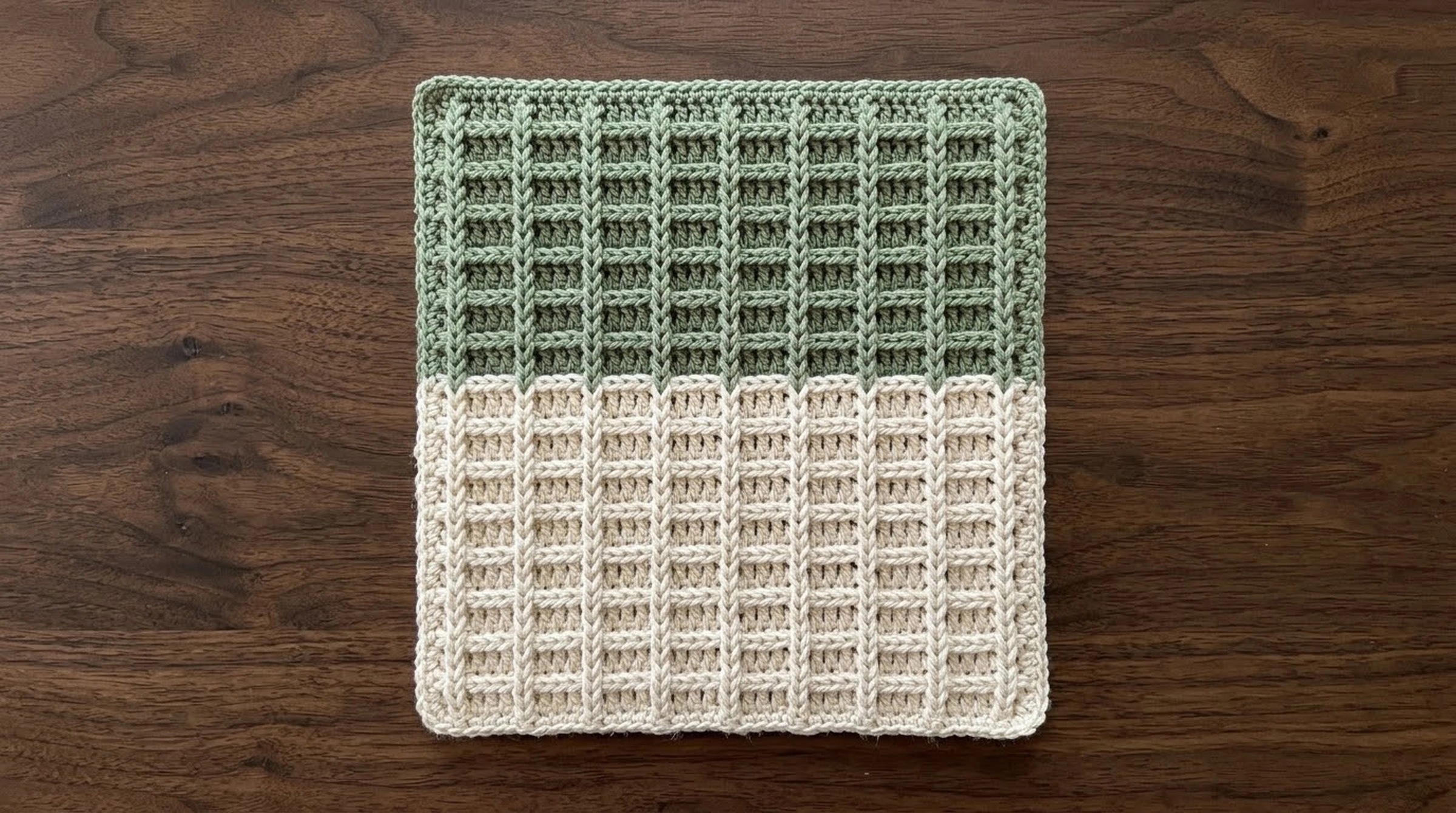
Free waffle stitch dishcloth pattern · about 7.7 x 8.1 in (estimated) · worsted cotton (#4) yarn · US H-8 (5 mm) hook · ch 29, 15 rows · US terms · free PDF (Letter + A4).
A waffle stitch dishcloth is a square of deep pockets. The front post double crochet stitches stand up as ridges, and the dc between them sink into small squares that hold soap, water and crumbs. It is the reason this stitch is a favorite for the kitchen.
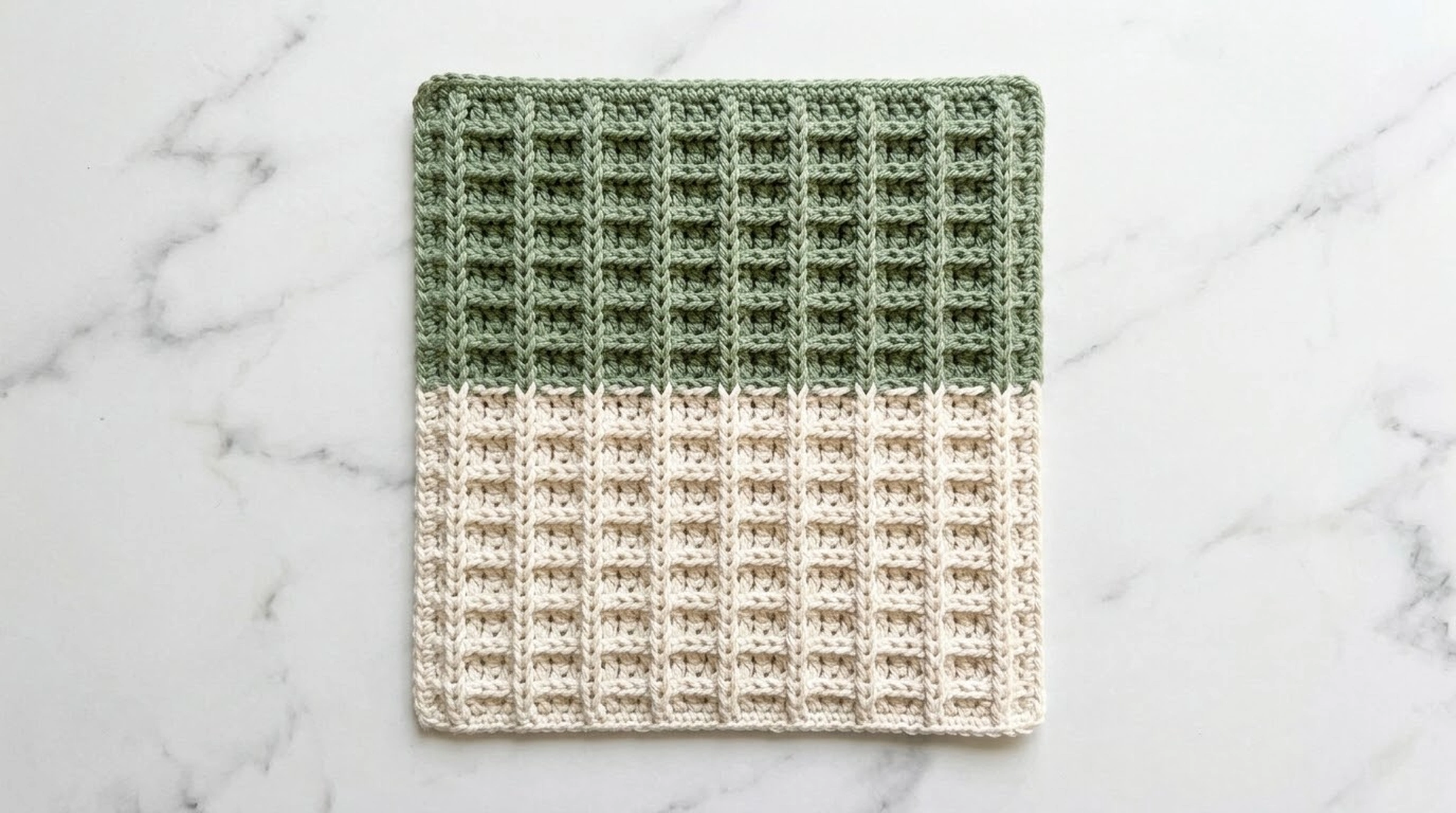
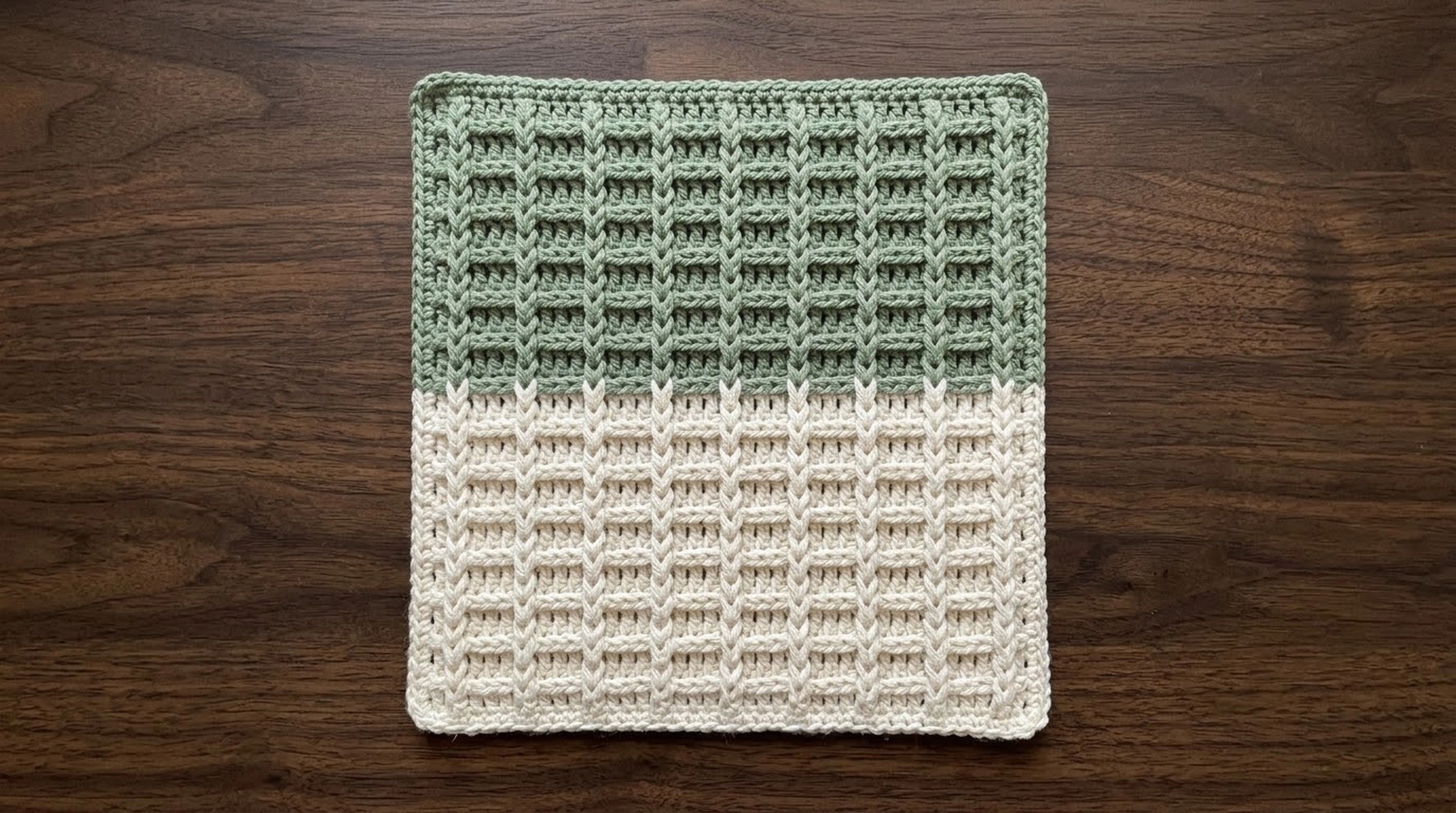
The pattern is two rows that repeat: Row A on the right side and Row B on the wrong side, both with fpdc. It is 27 stitches wide and 15 rows tall, in a cream band for Rows 1-8 and a sage green band for Rows 9-15. Our simulator checked every row. Nobody has crocheted this dishcloth yet, so the size, the yarn and the time are estimates.
- Finished size
- About 7.7 x 8.1 in (estimated)
- Yarn
- Worsted cotton (#4): about 34 yd cream and 30 yd sage green (estimated, with a 30 % margin)
- Hook
- US H-8 (5 mm)
- Gauge
- Suggested only: about 3.5 sts and 1.85 rows = 1 in (estimated)
- Rows
- Foundation ch 29, then 15 rows: 1 row of dc, then 7 Row A and 7 Row B
- Time
- About 105 to 140 minutes, with 1 color change and 4 ends to weave in (estimated, not timed)
- Skills
- ch, dc, fpdc, changing color in the last dc
✓ CookZya original design · Stitch counts checked row by row — Stitch counts checked row by row by our simulator. This dishcloth has not been crocheted and swatched by a person: size, yarn and time are estimates.
Materials
- Color A — cream, about 34 yd
- Color B — sage green, about 30 yd
- Yarn needle and scissors. Cotton yarn makes the best dishcloth: it stays firm and takes heat.
Notes
- US crochet terms. ch = chain, dc = double crochet, fpdc = front post double crochet, st(s) = stitch(es), yo = yarn over, rep = repeat. Fpdc: yo, push the hook from front to back to front around the upright stem (the post) of the stitch below, yo and pull up a loop, then (yo, pull through 2 loops) twice. A fpdc is worked in the place of a dc: it takes the spot of that st, so you skip nothing and never also work into its top. Each row after Row 1 starts with ch 2 and a turn (the ch 2 does not count as a st and is never worked into).
- Row 1 is the wrong side. Every odd row (1, 3, 5 … 15) is worked with the wrong side facing you and every even row (2, 4 … 14) with the right side facing you. You turn at the end of every row but the last. On the wrong-side rows the posts come toward you, so those rows put their ridges on the wrong side.
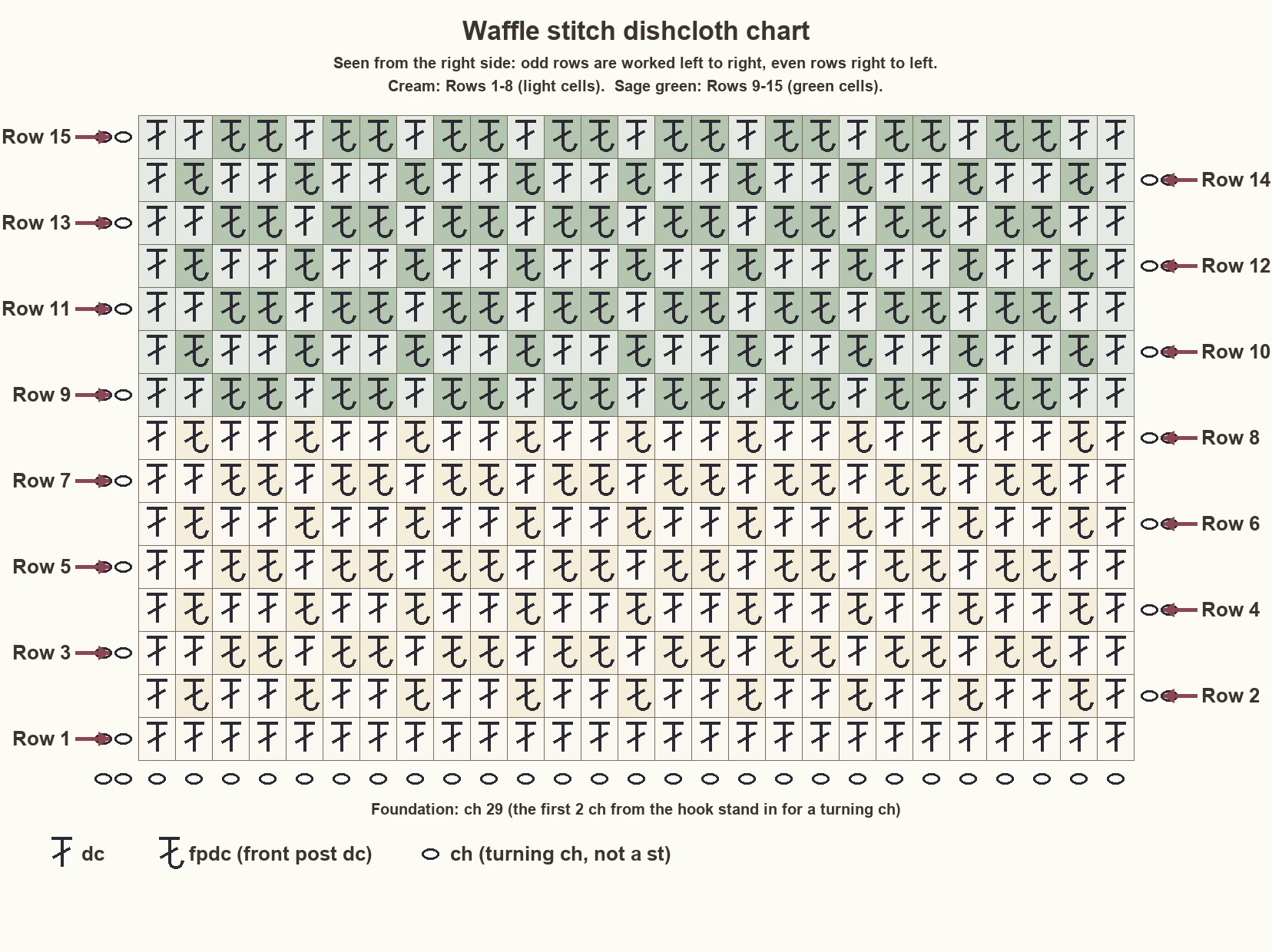
- Row A (even rows 2-14): dc, then (fpdc, 2 dc) 8 times, fpdc, dc = 27 sts (18 dc and 9 fpdc). Row B (odd rows 3-15): 2 dc, then (2 fpdc, dc) 8 times, dc = 27 sts (11 dc and 16 fpdc).
- Gauge: about 3.5 sts and 1.85 rows = 1 in (estimated). 27 sts are about 7.7 in wide.
- Other widths: chain a multiple of 3, plus 5 (here 3 x 8 + 5 = 29), and repeat the part between the * one more or one fewer time for each 3 sts. A bigger cloth is then a longer or wider square; a smaller one is a wash cloth. The numbers are estimates: your yarn and tension decide.
- The photo is a preview of the finished look, not crocheted and swatched by a person.
Waffle stitch dishcloth chart
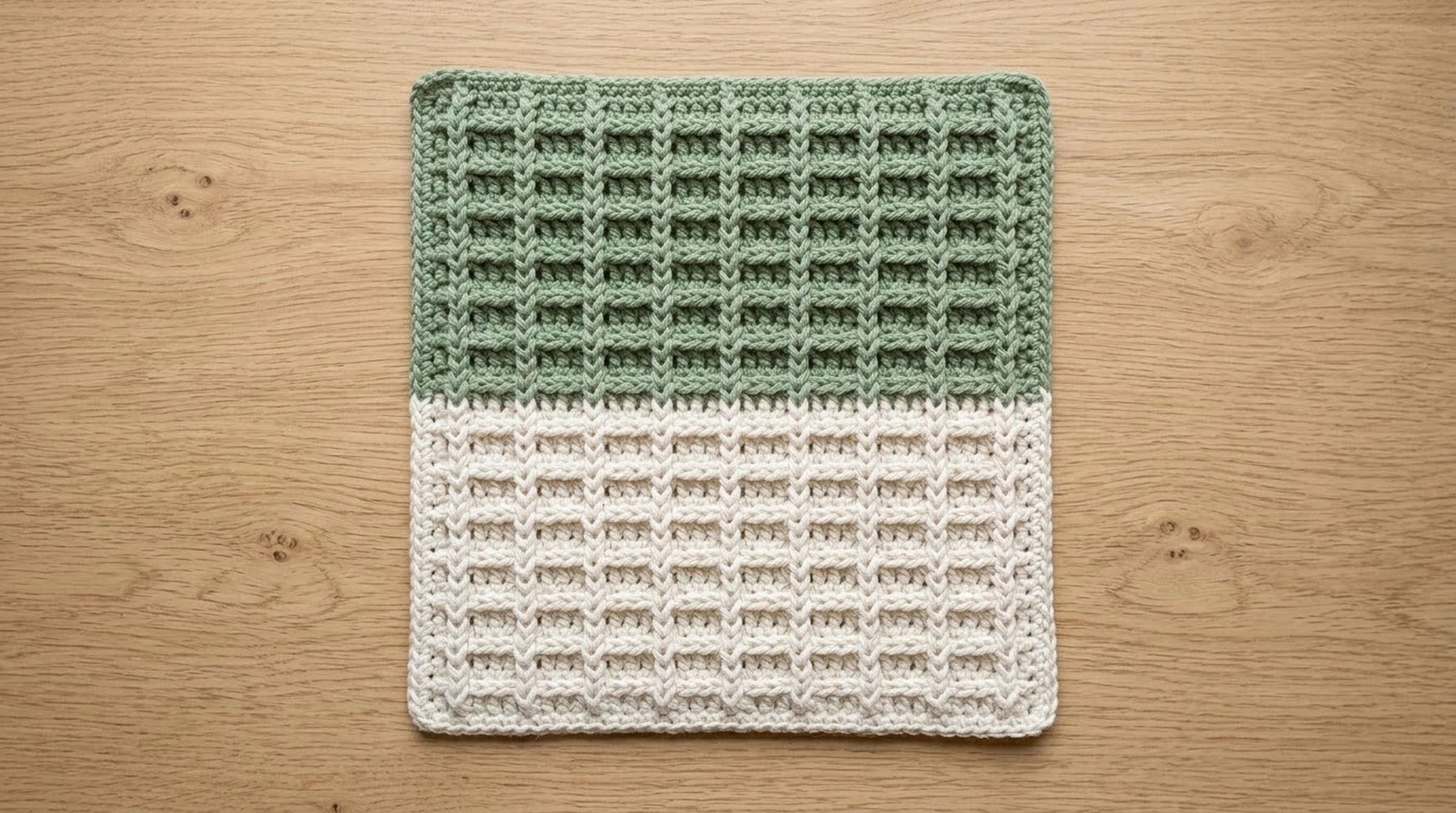
Waffle stitch dishcloth
Flat, in rows. Row 1 is the wrong side; the even rows are worked with the right side facing you. Cream for Rows 1-8, then sage green for Rows 9-15. The count after each row is the number of stitches you work in that row (the turning ch is not a st).
- With cream, ch 29. 29 ch
- Skip the first 2 ch from the hook (they stand in for a turning ch). Dc in the 3rd ch from the hook and in every ch to the end. (27 sts: 27 dc.) 27 sts: 27 dc
- Ch 2, turn. Dc in the 1st st. *Fpdc around the next st, dc in each of the next 2 sts; rep from * 7 more times (8 times in all). Fpdc around the next st, dc in the last st. (27 sts: 18 dc and 9 fpdc.) 27 sts: 18 dc and 9 fpdc
- Ch 2, turn. Dc in each of the first 2 sts. *Fpdc around each of the next 2 sts, dc in the next st; rep from * 7 more times (8 times in all). Dc in the last st. (27 sts: 11 dc and 16 fpdc.) 27 sts: 11 dc and 16 fpdc
- Ch 2, turn. Dc in the 1st st. *Fpdc around the next st, dc in each of the next 2 sts; rep from * 7 more times (8 times in all). Fpdc around the next st, dc in the last st, changing to sage green: work that last dc in cream until 2 loops are left, then pull sage green through them. Fasten off cream, leaving a 6-inch tail. (27 sts: 18 dc and 9 fpdc.) 27 sts: 18 dc and 9 fpdc
- Ch 2, turn. Dc in each of the first 2 sts. *Fpdc around each of the next 2 sts, dc in the next st; rep from * 7 more times (8 times in all). Dc in the last st. (27 sts: 11 dc and 16 fpdc.) 27 sts: 11 dc and 16 fpdc
- Ch 2, turn. Dc in the 1st st. *Fpdc around the next st, dc in each of the next 2 sts; rep from * 7 more times (8 times in all). Fpdc around the next st, dc in the last st. (27 sts: 18 dc and 9 fpdc.) 27 sts: 18 dc and 9 fpdc
- Ch 2, turn. Dc in each of the first 2 sts. *Fpdc around each of the next 2 sts, dc in the next st; rep from * 7 more times (8 times in all). Dc in the last st. (27 sts: 11 dc and 16 fpdc.) 27 sts: 11 dc and 16 fpdc
- Ch 2, turn. Dc in the 1st st. *Fpdc around the next st, dc in each of the next 2 sts; rep from * 7 more times (8 times in all). Fpdc around the next st, dc in the last st. (27 sts: 18 dc and 9 fpdc.) 27 sts: 18 dc and 9 fpdc
- Ch 2, turn. Dc in each of the first 2 sts. *Fpdc around each of the next 2 sts, dc in the next st; rep from * 7 more times (8 times in all). Dc in the last st. (27 sts: 11 dc and 16 fpdc.) Fasten off and weave in the ends. 27 sts: 11 dc and 16 fpdc
How the waffle stitch works
1 A fpdc goes around the post, not into the top
2 Row A and Row B are different
3 The posts shape the pockets
4 Change color in the last dc of Row 8
Finishing
Weave the 4 ends into stitches of their own color. Wash the cloth once, then lay it flat to dry. Cotton relaxes a little in the first wash, so the size may change.
Design notes
- Every row has 27 stitches: 3 x 8 + 3. Row A and Row B both keep that number, so the cloth stays square.
- The foundation is 27 + 2 = 29 ch: 27 stitches, plus the 2 ch that stand in for the turning ch.
Use it for
- A kitchen dishcloth. The deep pockets hold soap and scrub dishes well.
- A washcloth or a spa cloth for the bathroom, in a soft cotton.
- A set of cloths as a gift: change the two colors and keep the counts.
Tips
- Count after every row. Each row must end with 27 sts: the posts are easy to double or skip.
- Work each fpdc around the post of the stitch below it, never around the turning ch.
- Keep the fpdc loose enough to slide the hook through; a tight post pulls the edges in.
- Keep the edge dc at the start and end of the row: they hold the straight sides.
Common mistakes
- Working a dc into the top of a stitch that already has a fpdc. The fpdc replaces that dc.
- Working into the turning ch. It is not a st, so work into the first st; the row stays at 27.
- Mixing up Row A and Row B. Row A has fpdc one at a time, Row B has them in pairs.
Make it your own
- Swap the colors. Keep the change in the last dc of Row 8 and the counts stay the same.
- Make it in one color for a plain cloth, or add a third band by repeating the color change.
Care
- Wash it as the yarn label says, then lay it flat to dry.
More stitch and dishcloth patterns
- Filet Crochet Dishcloth (Free Heart Pattern) — a dishcloth worked in open and filled squares, with a heart chart
- Bobble Stitch Crochet — another raised stitch, worked in single crochet rows
- Granny Stitch Crochet — groups of 3 dc in color bands, a good next stitch
- Crochet for Beginners: 11 Free Patterns — 11 free patterns to make first, in order
FAQ
What is the waffle stitch?
It is a stitch made of dc and front post dc. The posts form ridges and the dc make small pockets, so the fabric looks like a waffle.
Why use the waffle stitch for a dishcloth?
The pockets hold water and soap, and the ridges scrub. The fabric is also thick, so it stays firm in the hand.
Which yarn is best?
Worsted cotton. It does not stretch much and can be washed hot. Acrylic works, but it holds less water.
How do I make the cloth bigger?
Chain a multiple of 3 plus 5, and repeat the part between the * one more time for every 3 sts. 29 ch gives 27 sts, about 7.7 in wide (estimated).
Has a person crocheted this dishcloth?
Not yet. Our simulator checked the counts row by row, but no one has made it. The size (about 7.7 x 8.1 in), the gauge, the yarn (about 34 yd cream and 30 yd sage green) and the time (about 105 to 140 minutes) are estimates. The photos are previews.
Copyright
© 2026 CookZya. Free for personal use: you may make and sell what you crochet. Please don't sell, copy or repost this pattern; link to it instead.