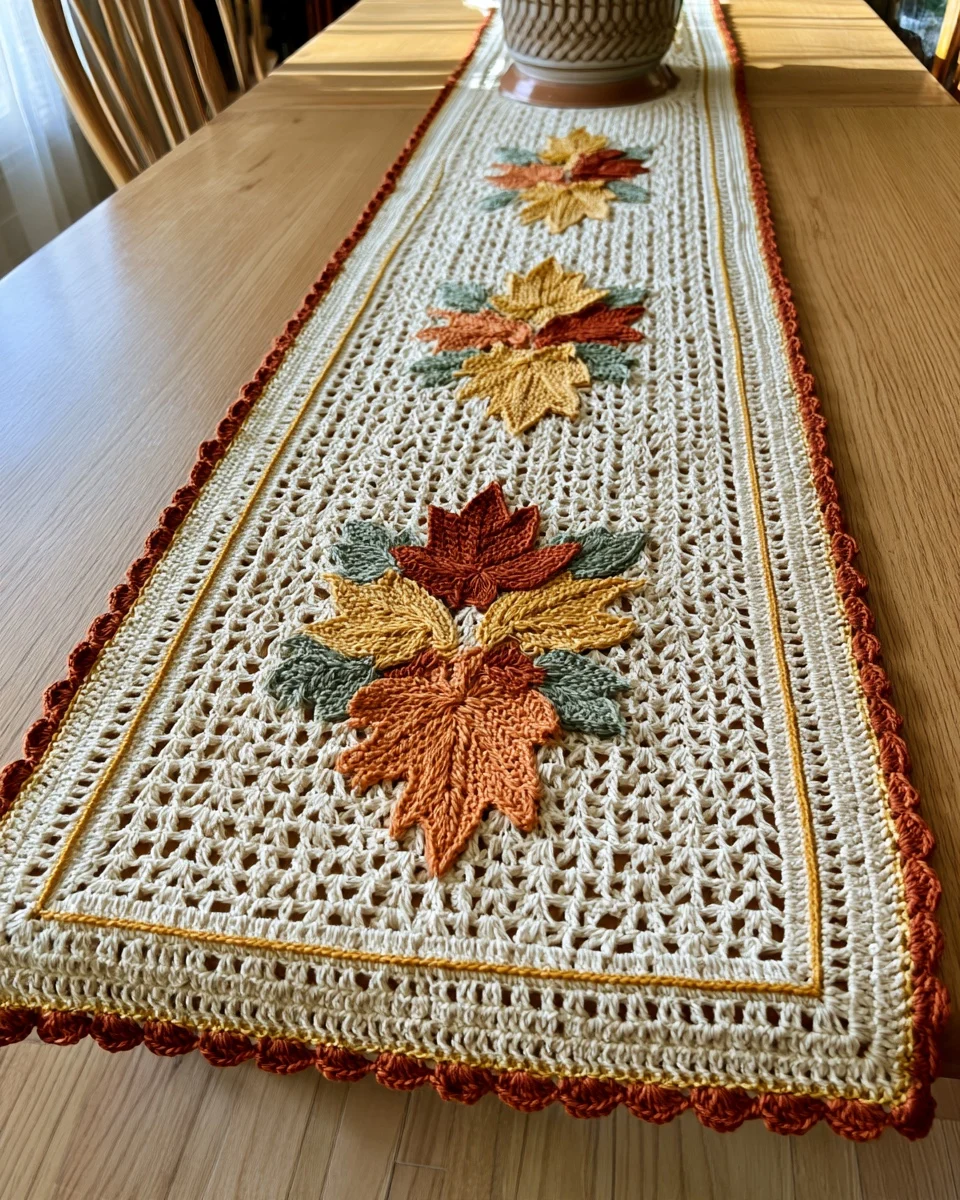
This autumn leaves table runner crochet pattern is an original CookZya design: a cream lace runner with three clusters of crochet maple leaves in rust, pumpkin orange and golden yellow, plus small sage green leaves. A gold and rust scalloped border frames it all, like a fall table in one piece.
You make it in three easy parts. First you crochet the lace panel in rows of V-stitches. Then you add the border in rounds. Last, you make the leaves and sew them on. Each part is small, so it is easy to pick up and put down on a busy week.
The finished runner is about 15 x 40.5 in (38 x 103 cm) with the border (approximate). Every row and round below was checked by our stitch simulator; the pattern has not been crochet-tested yet. Tick each row as you go — your progress stays saved in this browser.
- Finished size
- About 15 x 40.5 in (38 x 103 cm) with the border (approximate)
- Level
- Easy — for a confident beginner who knows ch, sc, hdc and dc
- Time
- About 10 to 12 hours over several evenings, estimated (not timed)
- Yarn
- Worsted weight (#4) cotton in 5 colors
- Hook
- US H-8 (5.0 mm)
- Gauge
- Suggested only, not swatched: 5 V-sts and 8 rows = 4 in in the lace
- Leaves
- 12 maple leaves and 12 small leaves, in 3 clusters
✓ CookZya original design · Stitch counts checked row by row — shape and size not tested. All 87 rows and rounds — the lace panel, the 5 border rounds and both leaves — were replayed by our stitch simulator, and a second reading made from the written text alone matched it stitch by stitch. This pattern has not been crochet-tested: tension, gauge and final size are up to your hands.
Materials
- Color A — cream, for the lace and the middle of the border, about 230 yd
- Color B — rust, for the scallops and 3 maple leaves, about 45 yd
- Color C — pumpkin orange, for 3 maple leaves, about 15 yd
- Color D — golden yellow, for 2 border rounds and 6 maple leaves, about 65 yd
- Color E — sage green, for 12 small leaves, about 25 yd
- Yardage is estimated from the stitch counts with a 20 % margin.
- 100 % cotton is best for a table runner: it lies flat, keeps the lace open and washes well.
- US H-8 (5.0 mm) hook, yarn needle, rust-proof pins, scissors.
Notes
- US crochet terms. ch = chain, sl st = slip stitch, sc = single crochet, hdc = half double crochet, dc = double crochet, tr = treble crochet (yarn over twice, then pull through 2 loops three times), sp = space, st(s) = stitch(es), rep = repeat, Rnd = round.
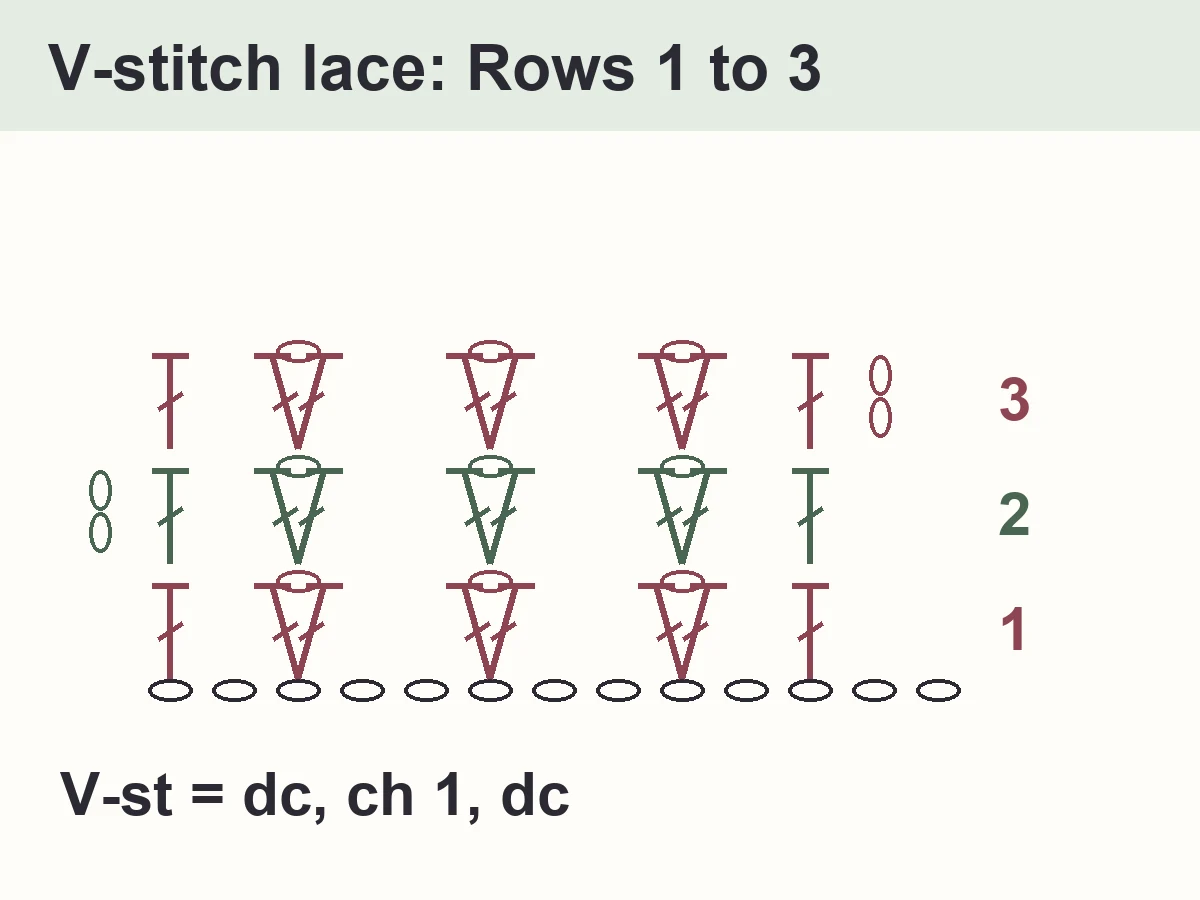
- V-st (V-stitch) = (dc, ch 1, dc) all in the same stitch or space. It makes the little V shapes of the lace.
- p (picot) = ch 3, sl st in 3rd ch from hook. It makes the sharp tip of each leaf point.
- Magic ring: wrap the yarn around two fingers, insert the hook under the strands, pull up a loop and ch 1. Work the first round over the ring, then pull the tail to close the hole.
- The ch 2 at the start of a lace row and the ch 1 at the start of a round do not count as stitches.
- The lace looks the same on both sides, so either side can face up.
How the autumn leaves table runner is built
Lace panel
With A. Rows are worked back and forth. Row 1 goes into the chain; every row after it is the same, so once Row 2 is done you only count rows. Work 75 rows in all.
- With A, ch 46. 46 ch
- Dc in 3rd ch from hook (the 2 skipped ch do not count as a stitch). *Skip next ch, V-st in next ch, skip next ch; rep from * 13 more times. Dc in last ch (14 V-sts and 2 edge dc). 30 dc, 14 ch-1 sps
- Ch 2 (does not count as a stitch), turn. Dc in first dc. *Skip next dc, V-st in next ch-1 sp, skip next dc; rep from * 13 more times. Dc in last dc (14 V-sts and 2 edge dc). 30 dc, 14 ch-1 sps
- Ch 2, turn. Repeat Row 2 (14 V-sts and 2 edge dc). 30 dc, 14 ch-1 sps
- Ch 2, turn. Repeat Row 2 (14 V-sts and 2 edge dc). 30 dc, 14 ch-1 sps
- Ch 2, turn. Repeat Row 2 (14 V-sts and 2 edge dc). 30 dc, 14 ch-1 sps
- Ch 2, turn. Repeat Row 2 (14 V-sts and 2 edge dc). 30 dc, 14 ch-1 sps
- Ch 2, turn. Repeat Row 2 (14 V-sts and 2 edge dc). 30 dc, 14 ch-1 sps
- Ch 2, turn. Repeat Row 2 (14 V-sts and 2 edge dc). 30 dc, 14 ch-1 sps
- Ch 2, turn. Repeat Row 2 (14 V-sts and 2 edge dc). 30 dc, 14 ch-1 sps
- Ch 2, turn. Repeat Row 2 (14 V-sts and 2 edge dc). 30 dc, 14 ch-1 sps
- Ch 2, turn. Repeat Row 2 (14 V-sts and 2 edge dc). 30 dc, 14 ch-1 sps
- Ch 2, turn. Repeat Row 2 (14 V-sts and 2 edge dc). 30 dc, 14 ch-1 sps
- Ch 2, turn. Repeat Row 2 (14 V-sts and 2 edge dc). 30 dc, 14 ch-1 sps
- Ch 2, turn. Repeat Row 2 (14 V-sts and 2 edge dc). 30 dc, 14 ch-1 sps
- Ch 2, turn. Repeat Row 2 (14 V-sts and 2 edge dc). 30 dc, 14 ch-1 sps
- Ch 2, turn. Repeat Row 2 (14 V-sts and 2 edge dc). 30 dc, 14 ch-1 sps
- Ch 2, turn. Repeat Row 2 (14 V-sts and 2 edge dc). 30 dc, 14 ch-1 sps
- Ch 2, turn. Repeat Row 2 (14 V-sts and 2 edge dc). 30 dc, 14 ch-1 sps
- Ch 2, turn. Repeat Row 2 (14 V-sts and 2 edge dc). 30 dc, 14 ch-1 sps
- Ch 2, turn. Repeat Row 2 (14 V-sts and 2 edge dc). 30 dc, 14 ch-1 sps
- Ch 2, turn. Repeat Row 2 (14 V-sts and 2 edge dc). 30 dc, 14 ch-1 sps
- Ch 2, turn. Repeat Row 2 (14 V-sts and 2 edge dc). 30 dc, 14 ch-1 sps
- Ch 2, turn. Repeat Row 2 (14 V-sts and 2 edge dc). 30 dc, 14 ch-1 sps
- Ch 2, turn. Repeat Row 2 (14 V-sts and 2 edge dc). 30 dc, 14 ch-1 sps
- Ch 2, turn. Repeat Row 2 (14 V-sts and 2 edge dc). 30 dc, 14 ch-1 sps
- Ch 2, turn. Repeat Row 2 (14 V-sts and 2 edge dc). 30 dc, 14 ch-1 sps
- Ch 2, turn. Repeat Row 2 (14 V-sts and 2 edge dc). 30 dc, 14 ch-1 sps
- Ch 2, turn. Repeat Row 2 (14 V-sts and 2 edge dc). 30 dc, 14 ch-1 sps
- Ch 2, turn. Repeat Row 2 (14 V-sts and 2 edge dc). 30 dc, 14 ch-1 sps
- Ch 2, turn. Repeat Row 2 (14 V-sts and 2 edge dc). 30 dc, 14 ch-1 sps
- Ch 2, turn. Repeat Row 2 (14 V-sts and 2 edge dc). 30 dc, 14 ch-1 sps
- Ch 2, turn. Repeat Row 2 (14 V-sts and 2 edge dc). 30 dc, 14 ch-1 sps
- Ch 2, turn. Repeat Row 2 (14 V-sts and 2 edge dc). 30 dc, 14 ch-1 sps
- Ch 2, turn. Repeat Row 2 (14 V-sts and 2 edge dc). 30 dc, 14 ch-1 sps
- Ch 2, turn. Repeat Row 2 (14 V-sts and 2 edge dc). 30 dc, 14 ch-1 sps
- Ch 2, turn. Repeat Row 2 (14 V-sts and 2 edge dc). 30 dc, 14 ch-1 sps
- Ch 2, turn. Repeat Row 2 (14 V-sts and 2 edge dc). 30 dc, 14 ch-1 sps
- Ch 2, turn. Repeat Row 2 (14 V-sts and 2 edge dc). 30 dc, 14 ch-1 sps
- Ch 2, turn. Repeat Row 2 (14 V-sts and 2 edge dc). 30 dc, 14 ch-1 sps
- Ch 2, turn. Repeat Row 2 (14 V-sts and 2 edge dc). 30 dc, 14 ch-1 sps
- Ch 2, turn. Repeat Row 2 (14 V-sts and 2 edge dc). 30 dc, 14 ch-1 sps
- Ch 2, turn. Repeat Row 2 (14 V-sts and 2 edge dc). 30 dc, 14 ch-1 sps
- Ch 2, turn. Repeat Row 2 (14 V-sts and 2 edge dc). 30 dc, 14 ch-1 sps
- Ch 2, turn. Repeat Row 2 (14 V-sts and 2 edge dc). 30 dc, 14 ch-1 sps
- Ch 2, turn. Repeat Row 2 (14 V-sts and 2 edge dc). 30 dc, 14 ch-1 sps
- Ch 2, turn. Repeat Row 2 (14 V-sts and 2 edge dc). 30 dc, 14 ch-1 sps
- Ch 2, turn. Repeat Row 2 (14 V-sts and 2 edge dc). 30 dc, 14 ch-1 sps
- Ch 2, turn. Repeat Row 2 (14 V-sts and 2 edge dc). 30 dc, 14 ch-1 sps
- Ch 2, turn. Repeat Row 2 (14 V-sts and 2 edge dc). 30 dc, 14 ch-1 sps
- Ch 2, turn. Repeat Row 2 (14 V-sts and 2 edge dc). 30 dc, 14 ch-1 sps
- Ch 2, turn. Repeat Row 2 (14 V-sts and 2 edge dc). 30 dc, 14 ch-1 sps
- Ch 2, turn. Repeat Row 2 (14 V-sts and 2 edge dc). 30 dc, 14 ch-1 sps
- Ch 2, turn. Repeat Row 2 (14 V-sts and 2 edge dc). 30 dc, 14 ch-1 sps
- Ch 2, turn. Repeat Row 2 (14 V-sts and 2 edge dc). 30 dc, 14 ch-1 sps
- Ch 2, turn. Repeat Row 2 (14 V-sts and 2 edge dc). 30 dc, 14 ch-1 sps
- Ch 2, turn. Repeat Row 2 (14 V-sts and 2 edge dc). 30 dc, 14 ch-1 sps
- Ch 2, turn. Repeat Row 2 (14 V-sts and 2 edge dc). 30 dc, 14 ch-1 sps
- Ch 2, turn. Repeat Row 2 (14 V-sts and 2 edge dc). 30 dc, 14 ch-1 sps
- Ch 2, turn. Repeat Row 2 (14 V-sts and 2 edge dc). 30 dc, 14 ch-1 sps
- Ch 2, turn. Repeat Row 2 (14 V-sts and 2 edge dc). 30 dc, 14 ch-1 sps
- Ch 2, turn. Repeat Row 2 (14 V-sts and 2 edge dc). 30 dc, 14 ch-1 sps
- Ch 2, turn. Repeat Row 2 (14 V-sts and 2 edge dc). 30 dc, 14 ch-1 sps
- Ch 2, turn. Repeat Row 2 (14 V-sts and 2 edge dc). 30 dc, 14 ch-1 sps
- Ch 2, turn. Repeat Row 2 (14 V-sts and 2 edge dc). 30 dc, 14 ch-1 sps
- Ch 2, turn. Repeat Row 2 (14 V-sts and 2 edge dc). 30 dc, 14 ch-1 sps
- Ch 2, turn. Repeat Row 2 (14 V-sts and 2 edge dc). 30 dc, 14 ch-1 sps
- Ch 2, turn. Repeat Row 2 (14 V-sts and 2 edge dc). 30 dc, 14 ch-1 sps
- Ch 2, turn. Repeat Row 2 (14 V-sts and 2 edge dc). 30 dc, 14 ch-1 sps
- Ch 2, turn. Repeat Row 2 (14 V-sts and 2 edge dc). 30 dc, 14 ch-1 sps
- Ch 2, turn. Repeat Row 2 (14 V-sts and 2 edge dc). 30 dc, 14 ch-1 sps
- Ch 2, turn. Repeat Row 2 (14 V-sts and 2 edge dc). 30 dc, 14 ch-1 sps
- Ch 2, turn. Repeat Row 2 (14 V-sts and 2 edge dc). 30 dc, 14 ch-1 sps
- Ch 2, turn. Repeat Row 2 (14 V-sts and 2 edge dc). 30 dc, 14 ch-1 sps
- Ch 2, turn. Repeat Row 2 (14 V-sts and 2 edge dc). 30 dc, 14 ch-1 sps
- Ch 2, turn. Repeat Row 2 (14 V-sts and 2 edge dc). Fasten off A. 30 dc, 14 ch-1 sps
Border
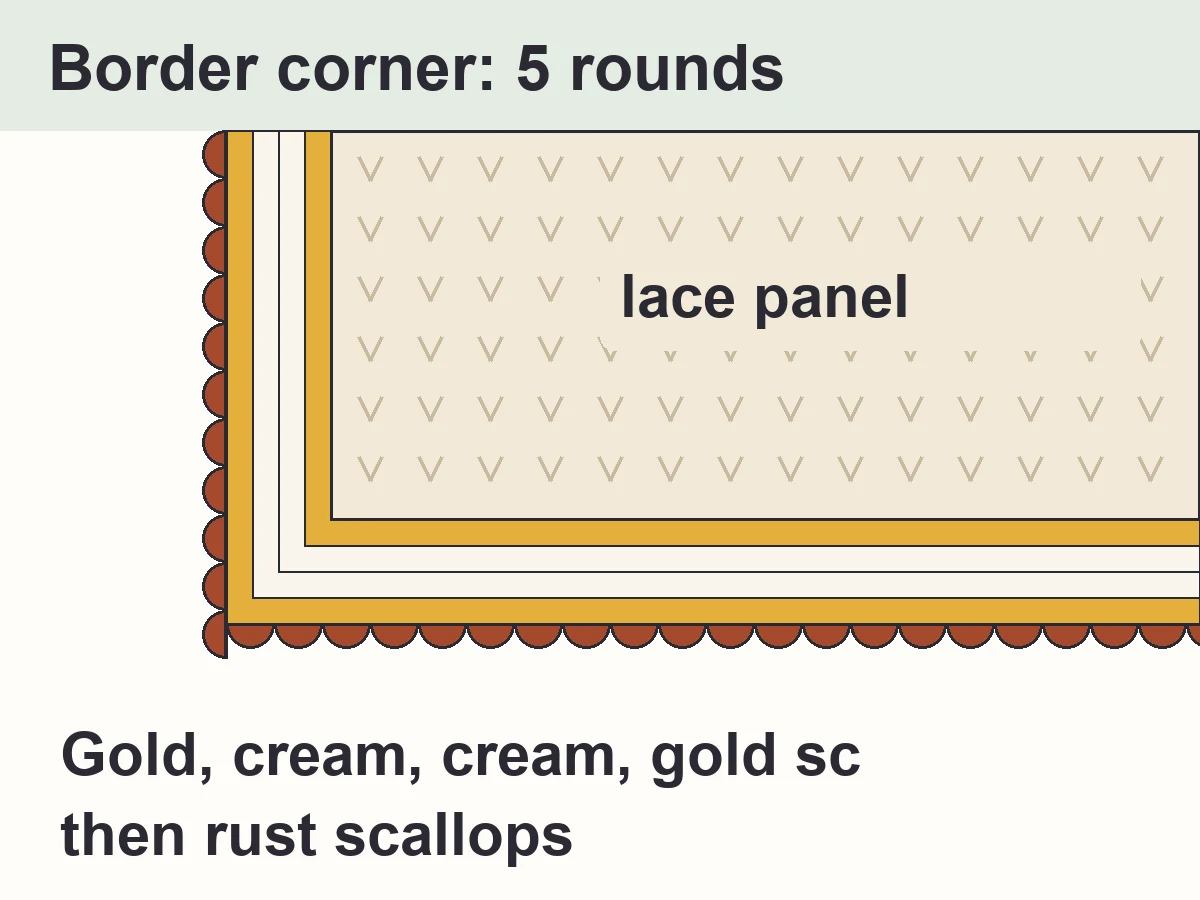
Five rounds all around the panel: gold, cream, cream, gold, then rust scallops. Each round gives its full count so you can check yourself at every corner. Rnd 4 ends with 420 sc, exactly 70 scallops of 6.
- Join D with sl st in the last dc of Row 75 (a corner). Ch 1 (does not count as a stitch), 3 sc in same dc (corner). Working across the top: sc in each of the next 42 sts and ch-1 sps, 3 sc in the edge dc (corner). Rotate to work down the long side: 2 sc in the end of each of the 75 rows, working around the edge dc or the ch 2 (150 sc). Rotate to work across the bottom of the foundation chain: 3 sc in the ch under the edge dc (corner), sc in each of the next 42 ch, 3 sc in the ch under the other edge dc (corner). The 2 skipped ch at the start of Row 1 stay unworked at the corner. Rotate to work up the other long side: 2 sc in the end of each of the 75 rows (150 sc). Join with sl st in first sc (396 sc). Fasten off D. 396 sc
- Join A with sl st in first sc of Rnd 1. Ch 1, sc in same st as join, 3 sc in next sc (corner), sc in each of next 44 sc, 3 sc in next sc (corner), sc in each of next 152 sc, 3 sc in next sc (corner), sc in each of next 44 sc, 3 sc in next sc (corner), sc in each of last 151 sc. Join with sl st in first sc (404 sc). 404 sc
- Do not fasten off. Ch 1, sc in same st as join, sc in next sc, 3 sc in next sc (corner), sc in each of next 46 sc, 3 sc in next sc (corner), sc in each of next 154 sc, 3 sc in next sc (corner), sc in each of next 46 sc, 3 sc in next sc (corner), sc in each of last 152 sc. Join with sl st in first sc (412 sc). Fasten off A. 412 sc
- Join D with sl st in first sc of Rnd 3. Ch 1, sc in same st as join, sc in each of next 2 sc, 3 sc in next sc (corner), sc in each of next 48 sc, 3 sc in next sc (corner), sc in each of next 156 sc, 3 sc in next sc (corner), sc in each of next 48 sc, 3 sc in next sc (corner), sc in each of last 153 sc. Join with sl st in first sc (420 sc). Fasten off D. 420 sc
- Join B with sl st in first sc of Rnd 4. Ch 1, sc in same st as join, *skip next 2 sc, 5 dc in next sc, skip next 2 sc, sc in next sc; rep from * around, ending the last repeat with skip next 2 sc. Join with sl st in first sc (70 scallops). Fasten off B. 70 scallops: 70 sc, 350 dc
Maple leaves
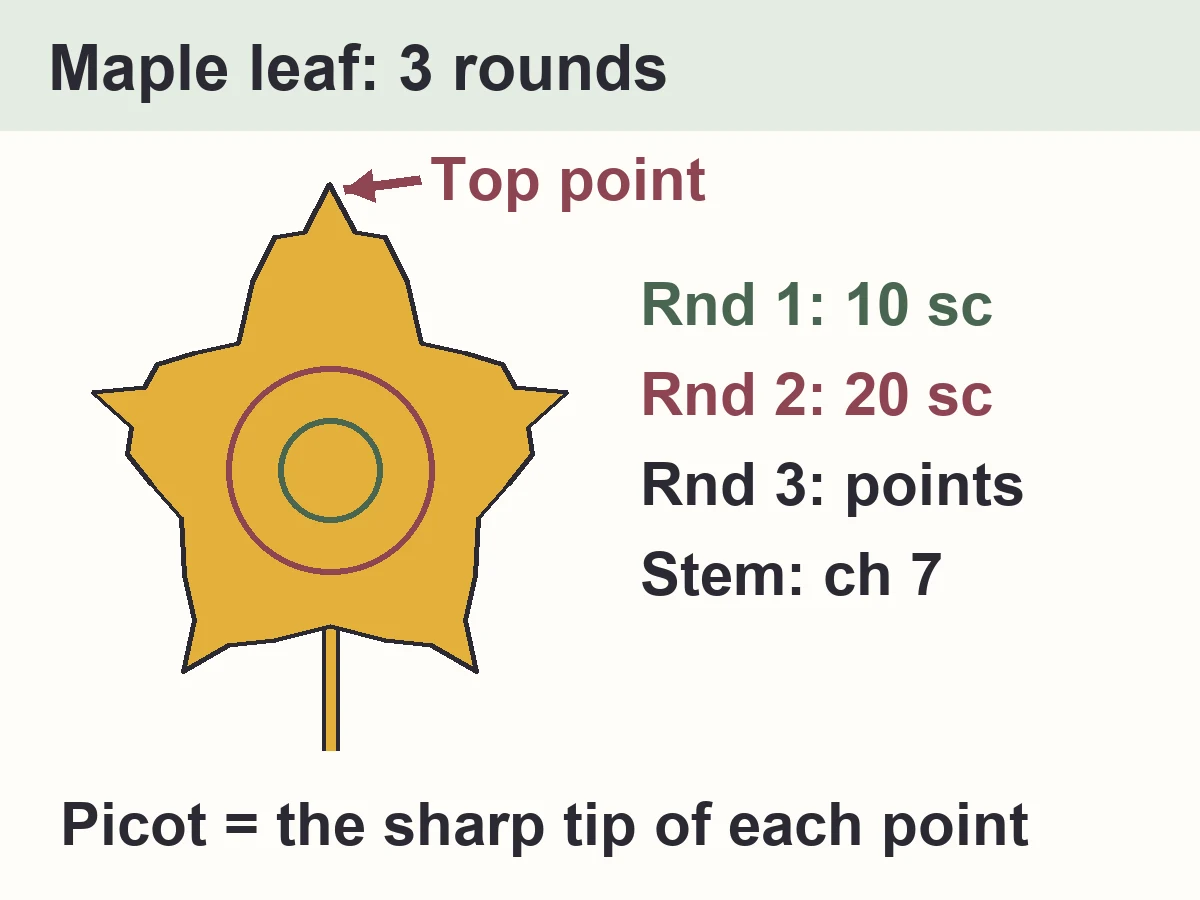
Make 12: 3 in B (rust), 3 in C (pumpkin orange) and 6 in D (golden yellow). Each leaf is about 3 1/2 in across (approximate). Rnd 3 uses three kinds of points, each worked over 3 sts. Small point: hdc in next st, (dc, p, dc) in next st, hdc in next st. Side point: (hdc, dc) in next st, (dc, p, dc) in next st, (dc, hdc) in next st. Top point: (dc, tr) in next st, (tr, p, tr) in next st, (tr, dc) in next st.
- Make a magic ring. Ch 1 (does not count as a stitch), 10 sc in the ring. Pull the tail to close the ring. Join with sl st in first sc (10 sc). 10 sc
- Ch 1, 2 sc in same st as join and in each st around. Join with sl st in first sc (20 sc). 20 sc
- Ch 1, sc in same st as join, small point, sc in next st, side point, sc in next st, top point, sc in next st, side point, sc in next st, small point. Join with sl st in first sc (5 points). Do not fasten off. 5 sc, 8 hdc, 14 dc, 4 tr, 5 p
- Right after the join of Rnd 3, ch 7 for the stem. It hangs from the first sc, between the two small points. Fasten off, leaving a 12 in tail for sewing. 7 ch
Small green leaves
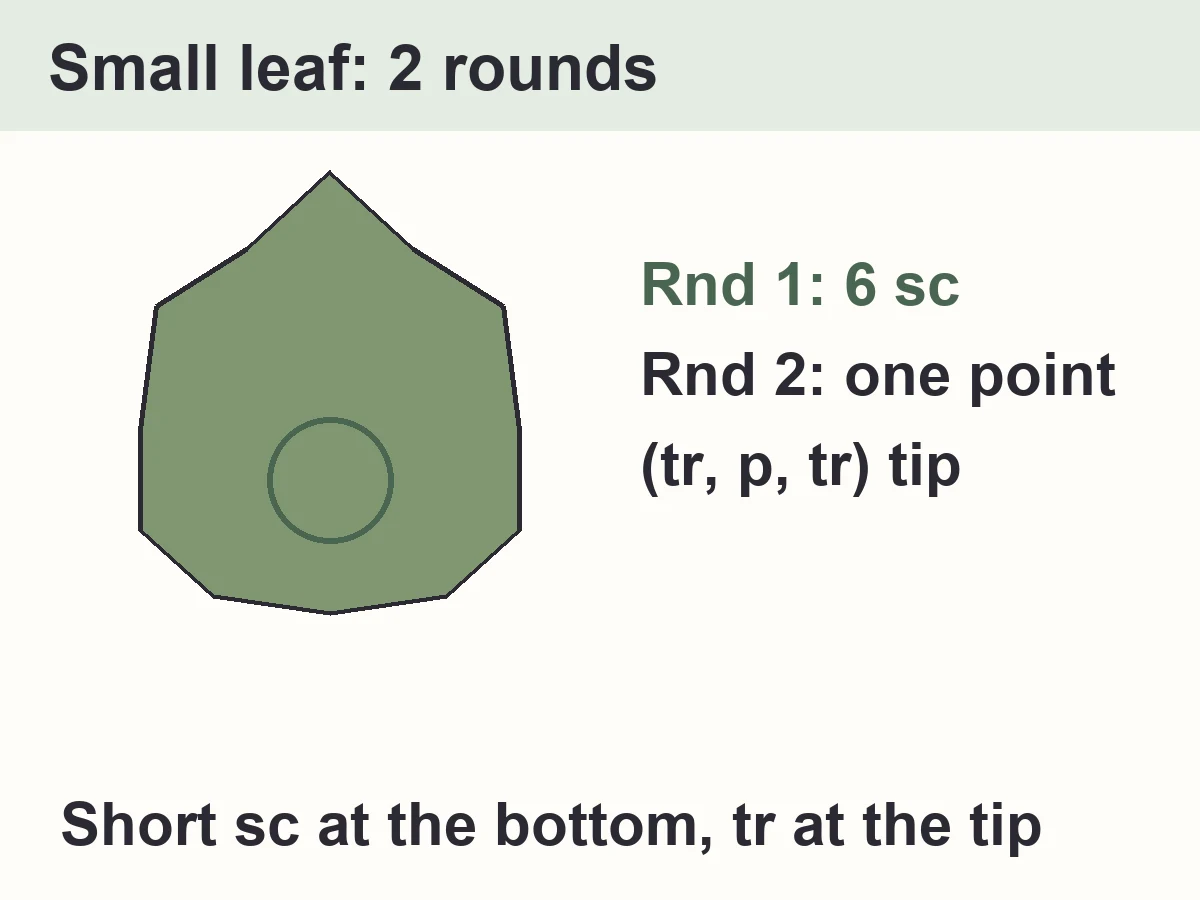
Make 12 in E (sage green). Each leaf is about 2 in long (approximate).
- Make a magic ring. Ch 1 (does not count as a stitch), 6 sc in the ring. Pull the tail to close the ring. Join with sl st in first sc (6 sc). 6 sc
- Ch 1, sc in same st as join, (hdc, dc) in next st, (dc, tr) in next st, (tr, p, tr) in next st, (tr, dc) in next st, (dc, hdc) in next st. Join with sl st in first sc. Fasten off, leaving an 8 in tail for sewing. 1 sc, 2 hdc, 4 dc, 4 tr, 1 p
Putting the runner together
1 Block the pieces
2 Lay out the three clusters
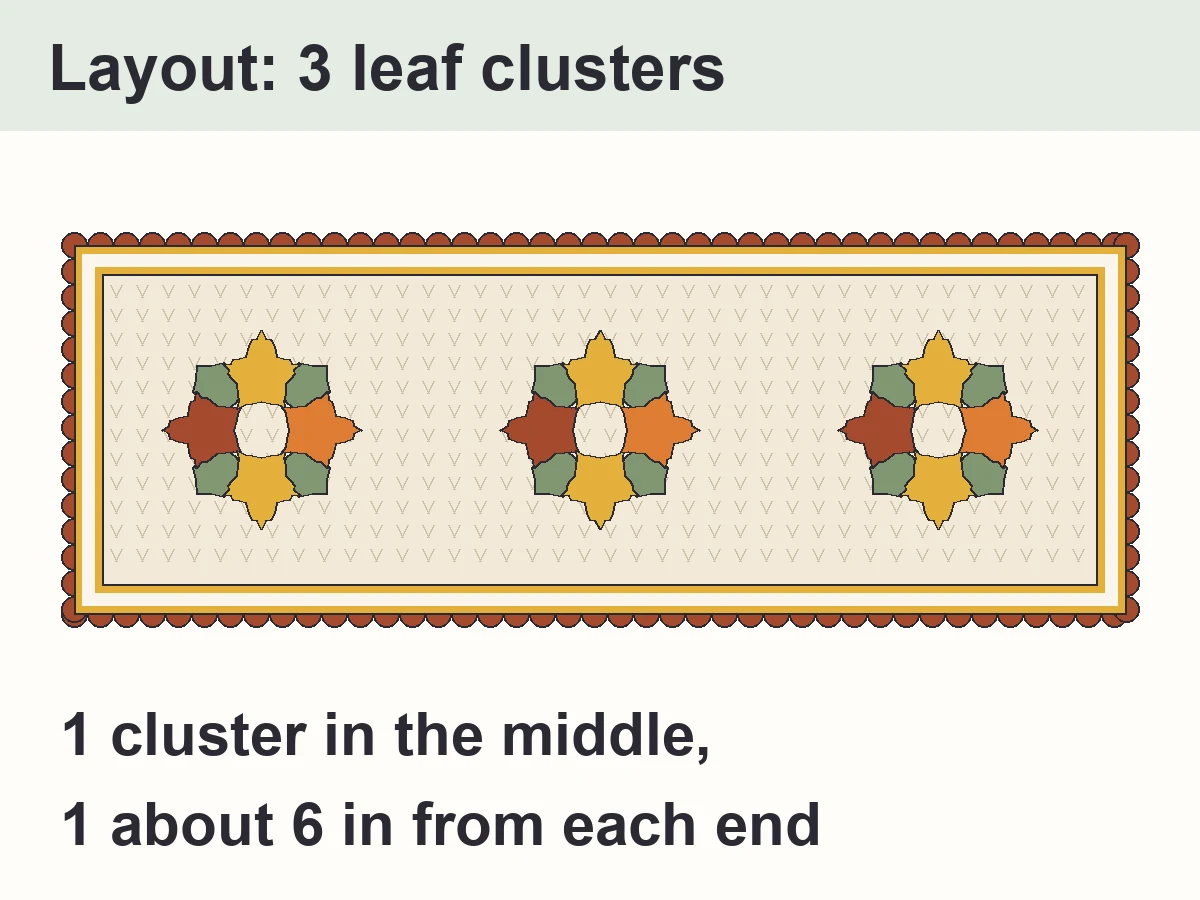
3 Pin and sew each leaf
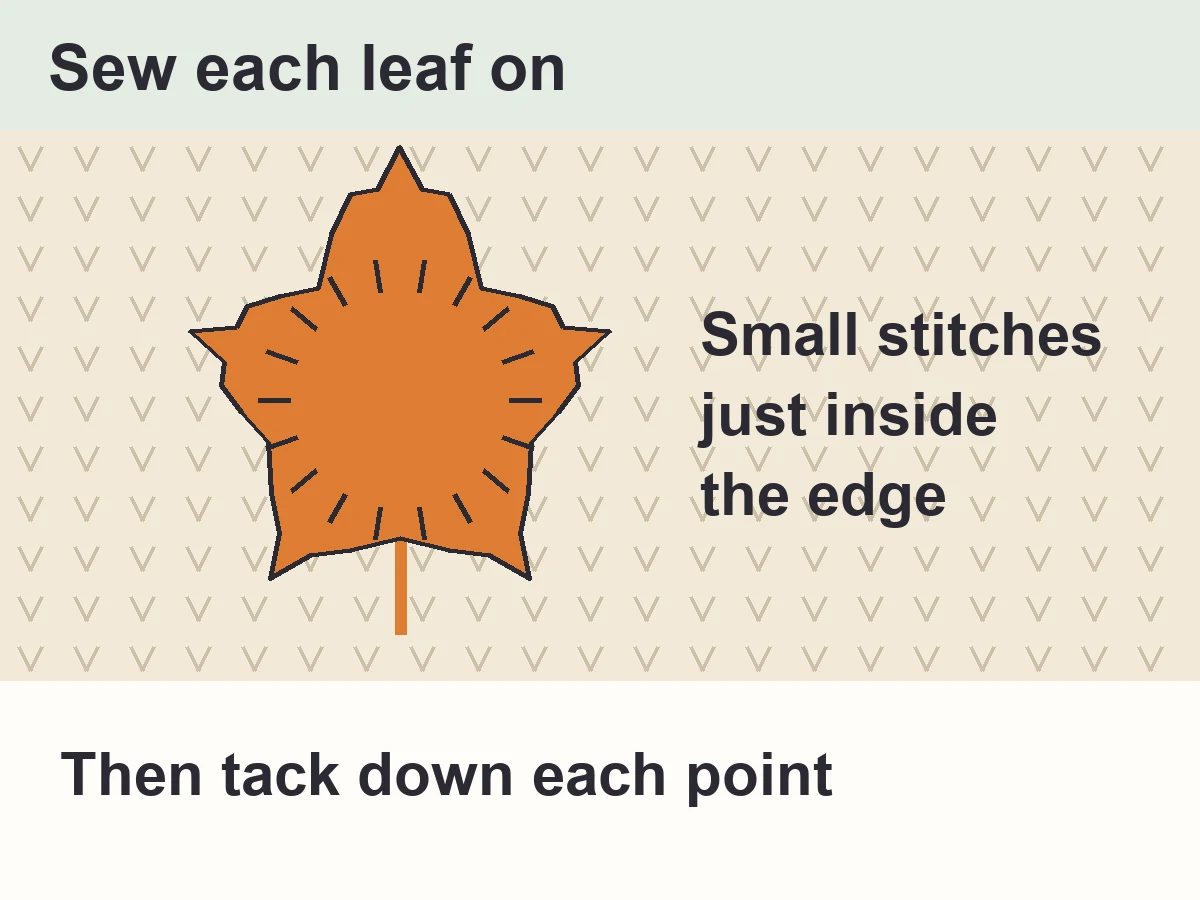
4 Finish
Finishing
Weave in any last ends on the back. Lay the runner flat to store it, or roll it around a tube with the leaves facing out, so the points do not crease.
Design notes
- The V-stitch lace is open and light, so the leaves stand out on it, and every lace row is the same.
- Rounds 2 to 4 of the border each add 2 sc at every corner, so the corners stay flat and square.
- The rows come in steps of 3 on purpose: with 75 rows, Rnd 4 of the border has 420 sc, and that divides into scallops of 6 with nothing left over.
- Each leaf point is a little fan of taller stitches with a picot on top; the top point uses treble crochet, so it is the longest, like a real maple leaf.
Tips for a neat autumn leaves table runner
- Put a stitch marker in the last dc of each lace row: it is the stitch most often missed.
- Count the V-sts every few rows. You should always have 14.
- In Rnd 1 of the border, the corner sc go into the TOP of the edge stitch, and the 2 sc of each row go into the SIDE of the row. So the first and last rows get both: that is normal.
- Make the leaves first if you like: they are quick, and seeing the colors together keeps you going.
- Test each color before you sew: soak a strand in warm water with a white tissue. If the color runs, wash that yarn first so the cream lace stays clean.
Common mistakes
- Counting the ch 2 at the start of a lace row as a stitch: the row grows by one V on each side.
- Working the V-st into the dc instead of the ch-1 sp: the lace slants.
- Working only 1 sc in the end of each row in Rnd 1 of the border: the long sides pull in.
- Pulling the sewing stitches tight: the lace puckers under the leaf.
Make it your own
- Shorter or longer runner: change the number of lace rows in steps of 3 (each 3 rows add about 1 1/2 in). Rnd 1 of the border then has 4 x rows + 96 sc, and the scallops still close.
- Coffee table or dresser size: one cluster in the middle is enough.
- Harvest colors: swap the cream lace for oatmeal and the green leaves for brown.
- Thanksgiving: add a few small leaves along the long sides between the clusters.
Care
- Hand wash cold with a mild soap, or machine wash cold in a mesh bag on a gentle cycle.
- Lay flat to dry and pin the leaf points open again.
- Iron on low from the back, with a towel under the leaves.
More crochet patterns for your table
- Halloween Ghost and Pumpkin Table Runner — another runner for the fall table, with pumpkins and ghosts in colorwork
- Tulip Table Runner — the spring runner to swap in when the leaves come off
- Easy Crochet Pumpkin — three sizes of stuffed pumpkins to set on the runner
- Crochet Pumpkin Coaster — matching coasters in the same fall colors
FAQ
Is this autumn leaves table runner crochet pattern good for beginners?
Yes, for a confident beginner. If you can chain and work sc, hdc and dc, you can make it. The lace repeats one row, and each leaf is only 2 or 3 short rounds. New stitches like the V-stitch and the picot are explained in the notes.
How big is the finished runner?
With the suggested gauge it is about 15 x 40.5 in (38 x 103 cm) with the border (approximate). Your yarn and hook change the size, so measure a few rows of lace before you go on.
What yarn is best for a crochet table runner?
Worsted weight 100 % cotton. It lies flat, keeps the lace open, takes heat from dishes and washes well. Acrylic works too, but it is softer and may not stay as flat.
How much yarn do I need?
About 230 yd of cream, 45 yd of rust, 15 yd of pumpkin orange, 65 yd of golden yellow and 25 yd of sage green, worsted weight. These are estimates with a 20 % margin.
How long does it take to crochet?
About 10 to 12 hours in all, estimated: most of it is the lace panel, about 2 hours for the border, and 10 to 15 minutes per leaf. It is a nice project to spread over a few fall evenings.
Can I make the runner longer?
Yes. Add lace rows in steps of 3, about 1 1/2 in each time. The border counts change, but the scallops still close evenly, and you can add a fourth cluster of leaves.
Can I sell the runners I make?
Yes, you may sell the runners you crochet yourself. Please don't sell or repost the pattern; link to this page instead.
Copyright
© 2026 CookZya — original design. Free for personal use: you may make and sell the runners you crochet. Please don't sell, copy or repost this pattern; link to this page instead.