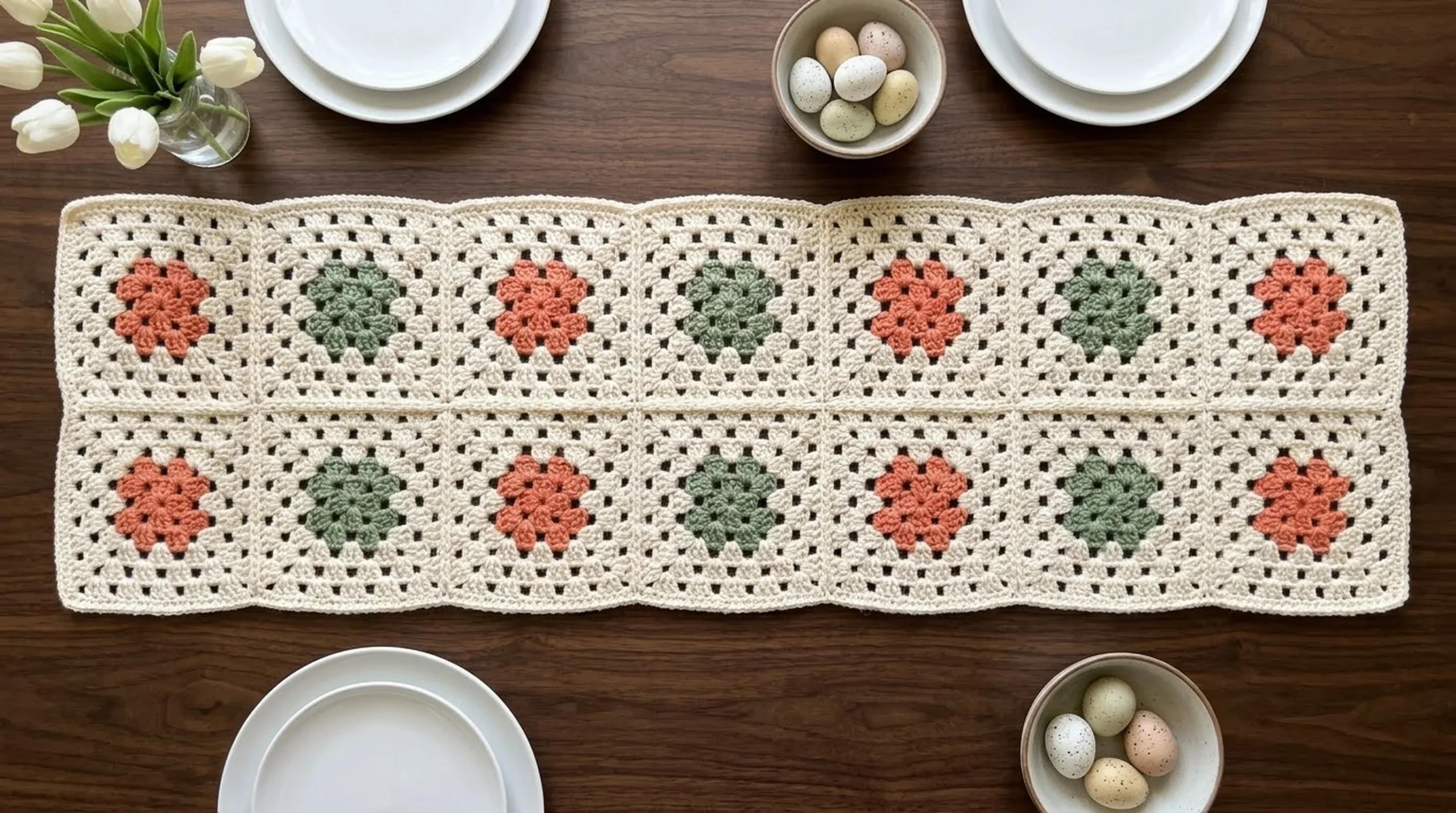
Free spring granny square table runner pattern · about 13 x 43 in · worsted yarn in coral, sage green and cream, US H-8 hook.
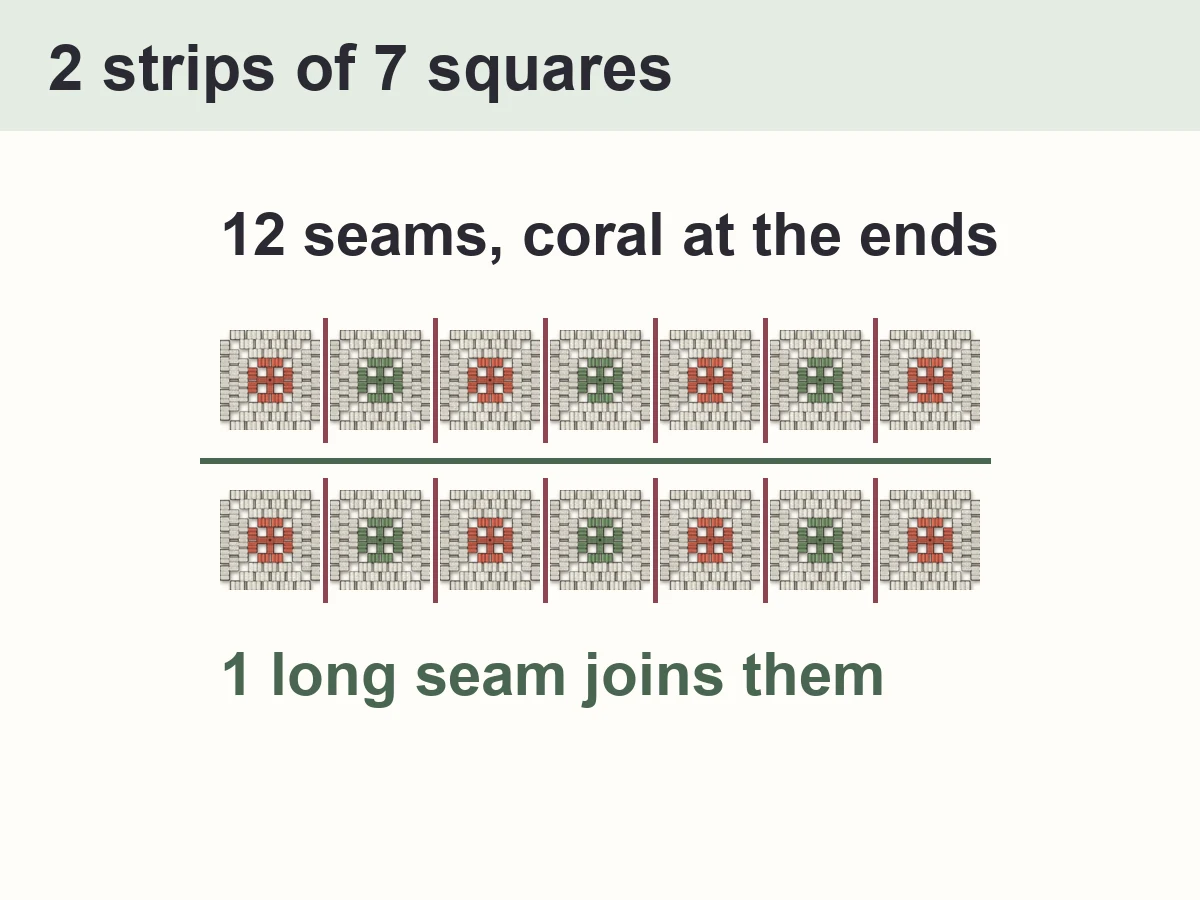
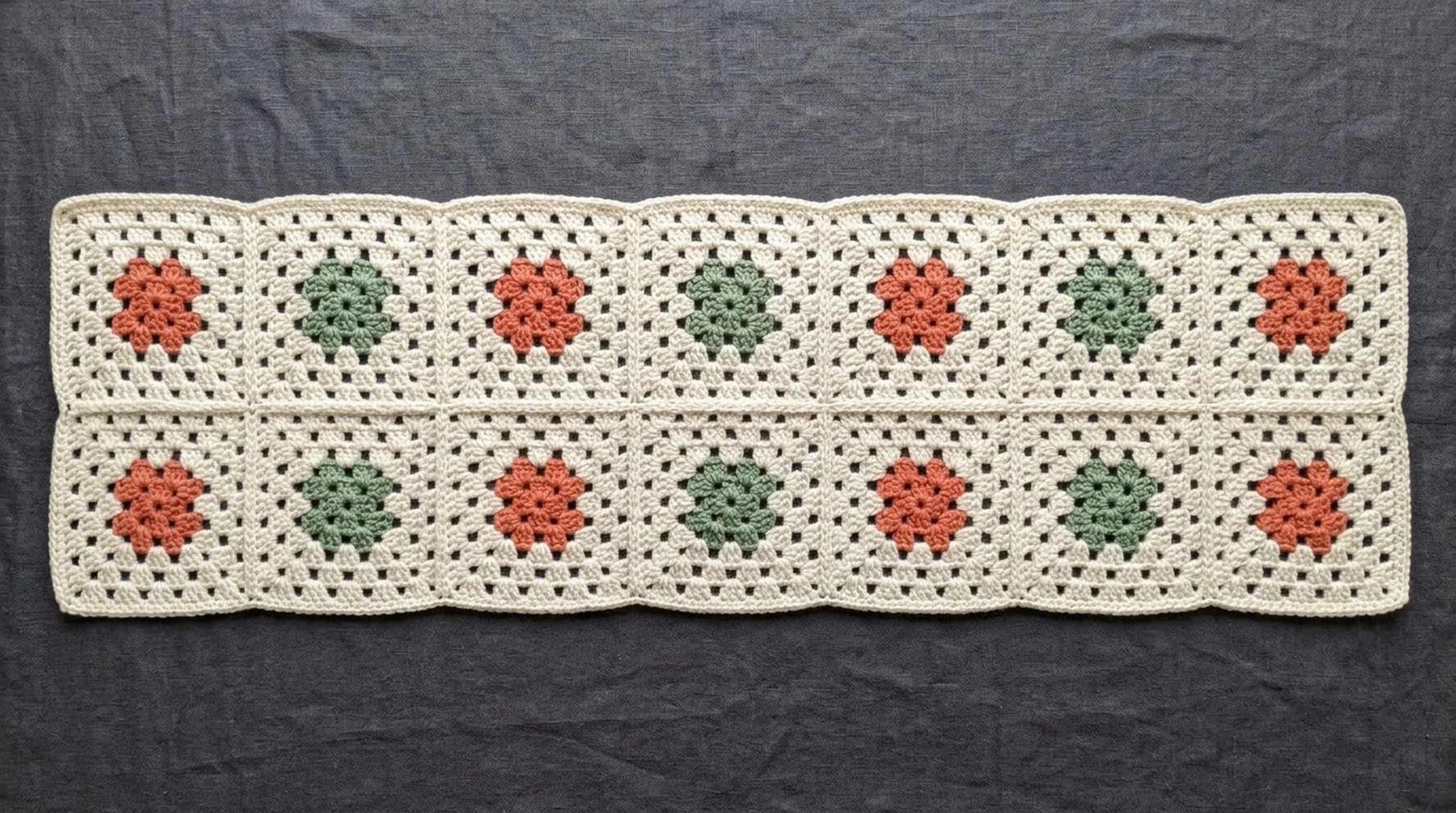
A coral and sage table runner for spring: 14 classic granny squares in 2 strips of 7, ready for Easter brunch and still pretty on the table at Mother's Day. Each square has a coral or sage green center and 3 cream rounds; the 2 colors take turns along each strip, coral at both ends, and the strips are joined so each coral faces a coral.
2 rounds of single crochet in cream frame the whole runner. Our stitch simulator checked every round of the square and of the border.
- Finished size
- About 13 in wide and 43 in long (estimated)
- Yarn
- Worsted weight (#4): about 50 yd coral, 40 yd sage, 370 yd cream (estimated, with a 30 % margin; buy all the cream from one dye lot)
- Hook
- US H-8 (5.0 mm); a US I-9 (5.5 mm) for the seams
- Gauge
- Suggested only: one 5-round square = about 6 in from side to side
- Squares
- 14: 8 coral centers, 6 sage centers
- Time
- About 12 to 16 hours: 14 squares, 12 short seams, 1 long seam, the border and about 84 ends to weave in (estimated, not timed)
- Skills
- ch, sl st, sc, dc, magic ring, joining squares with a slip-stitch seam
✓ CookZya original design · Stitch counts checked round by round — Stitch counts checked round by round by our simulator. This pattern has not been crocheted and swatched by a person: size, yarn and time are estimates, and your runner will differ a little.
Materials
- Color R — coral, about 50 yd
- Color G — sage green, about 40 yd
- Color W — cream, about 370 yd
- Yarn needle, scissors, a few stitch markers or pins.
Notes
- US crochet terms. ch = chain, sl st = slip stitch, sc = single crochet, dc = double crochet, sp = space, st(s) = stitch(es), rep = repeat, Rnd = round.
- Magic ring: wrap the yarn twice around two fingers, insert the hook under the strands, pull up a loop and ch 1 to lock it (this ch 1 does not count). Prefer a chain ring? Ch 4, sl st in the first ch.
- Ch 3 (counts as a dc): the 3 chains at the start of a round stand in for the first dc; you join in the top (3rd chain) of it.
- Gauge: make one square first with the US H-8 hook. It should measure about 6 in. Bigger squares make a bigger runner and use more yarn (estimates: your yarn and tension decide).
- Before you seam, block all 14 squares to match your first one: pin, mist and let them dry.
- The slip-stitch seams leave a small ridge on the wrong side: lay the runner ridge side down.
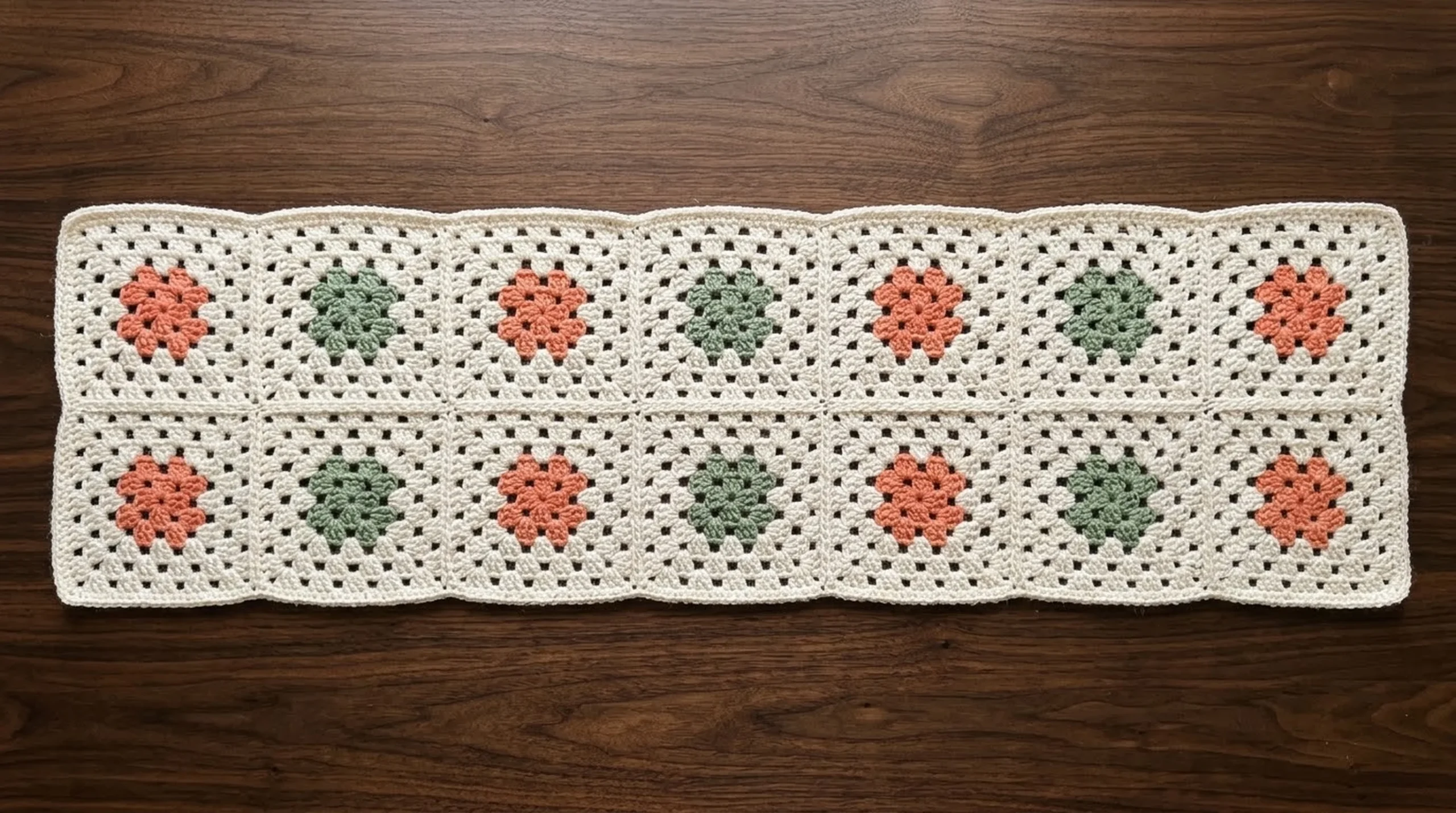
- Photos are previews of the finished look, not a crocheted sample.
Spring granny square table runner charts and plans
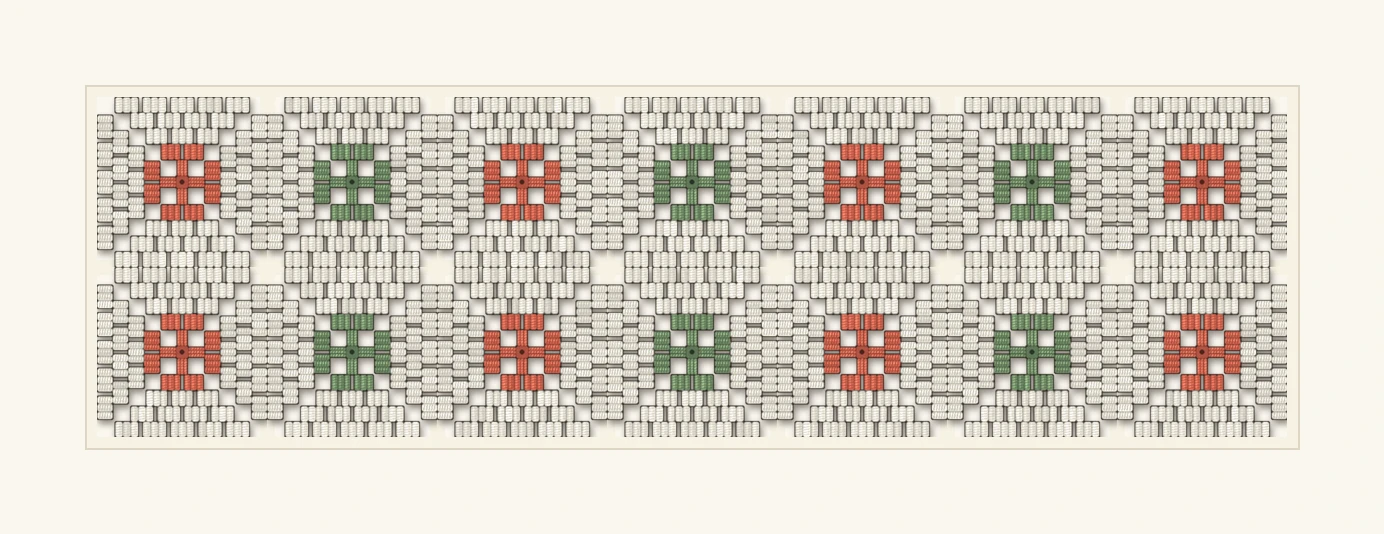
Granny square
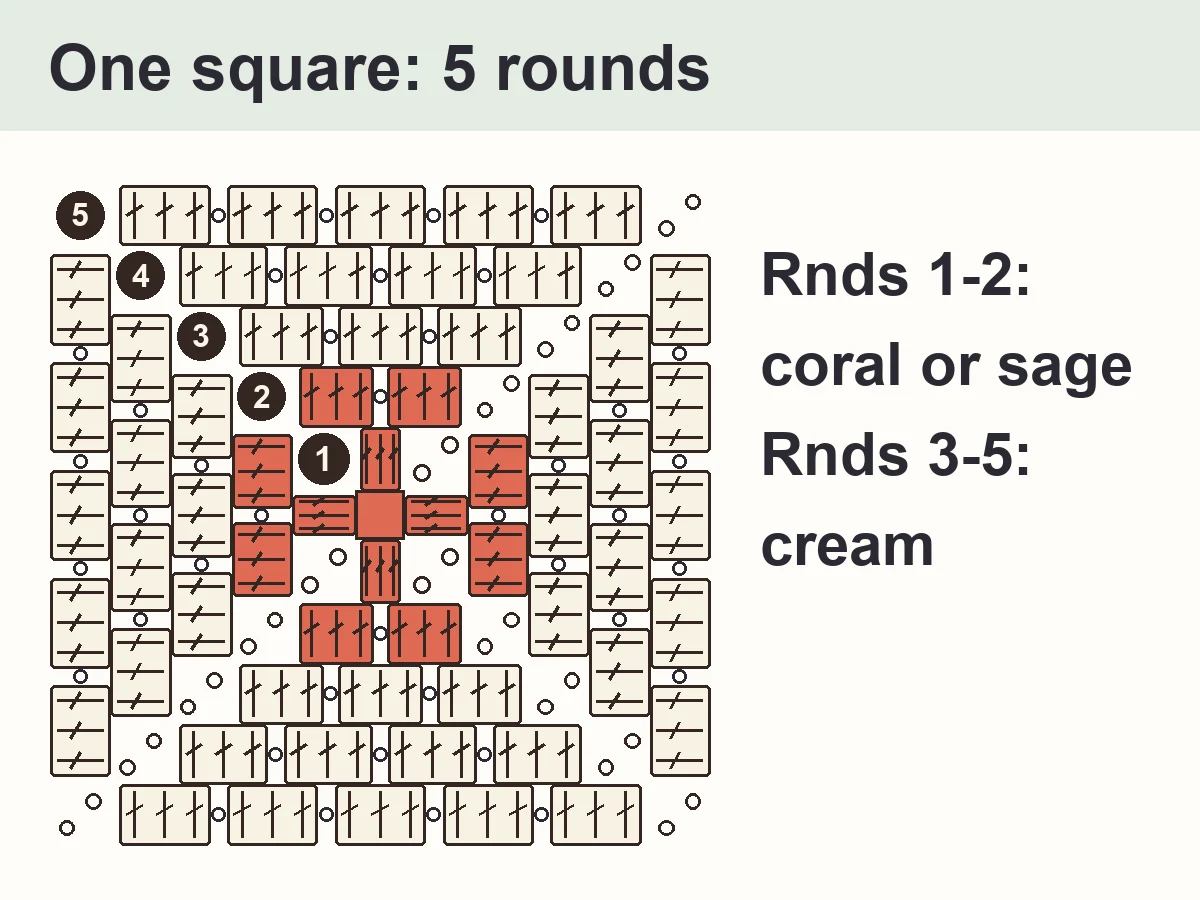
Make 14 squares: 8 with coral centers and 6 with sage centers. Right side facing you; you never turn.
- With coral (8 squares) or sage green (6 squares), make a magic ring. Ch 3 (counts as the first dc), 2 dc in the ring, ch 2. *3 dc in the ring, ch 2; rep from * 2 more times. Pull the tail to close the ring. Join with sl st in the top of the beginning ch-3 (12 dc in 4 groups, 4 ch-2 corner sps). 12 dc, 4 ch-2 sps
- Sl st in each of next 2 dc and in the next ch-2 sp. Ch 3 (counts as a dc), (2 dc, ch 2, 3 dc) in the same sp, ch 1 (it goes over the 3 dc of Rnd 1), *(3 dc, ch 2, 3 dc) in the next ch-2 sp, ch 1; rep from * 2 more times. Join with sl st in the top of the beginning ch-3 (24 dc in 8 groups, 4 ch-2 corner sps, 4 ch-1 sps). Fasten off, leaving a 6-inch tail. 24 dc, 4 ch-2 sps, 4 ch-1 sps
- Join cream with sl st in any ch-2 corner sp. Ch 3 (counts as a dc), (2 dc, ch 2, 3 dc) in the same sp, ch 1, *3 dc in the next ch-1 sp, ch 1, (3 dc, ch 2, 3 dc) in the next ch-2 sp, ch 1; rep from * 2 more times. Last side: 3 dc in the next ch-1 sp, ch 1. Join with sl st in the top of the beginning ch-3 (36 dc in 12 groups, 4 ch-2 corner sps, 8 ch-1 sps). 36 dc, 4 ch-2 sps, 8 ch-1 sps
- Sl st in each of next 2 dc and in the next ch-2 sp. Ch 3 (counts as a dc), (2 dc, ch 2, 3 dc) in the same sp, ch 1, *[3 dc in the next ch-1 sp, ch 1] 2 times, (3 dc, ch 2, 3 dc) in the next ch-2 sp, ch 1; rep from * 2 more times. Last side: [3 dc in the next ch-1 sp, ch 1] 2 times. Join with sl st in the top of the beginning ch-3 (48 dc in 16 groups, 4 ch-2 corner sps, 12 ch-1 sps). 48 dc, 4 ch-2 sps, 12 ch-1 sps
- Sl st in each of next 2 dc and in the next ch-2 sp. Ch 3 (counts as a dc), (2 dc, ch 2, 3 dc) in the same sp, ch 1, *[3 dc in the next ch-1 sp, ch 1] 3 times, (3 dc, ch 2, 3 dc) in the next ch-2 sp, ch 1; rep from * 2 more times. Last side: [3 dc in the next ch-1 sp, ch 1] 3 times. Join with sl st in the top of the beginning ch-3 (60 dc in 20 groups, 4 ch-2 corner sps, 16 ch-1 sps). Fasten off, leaving a 6-inch tail. 60 dc, 4 ch-2 sps, 16 ch-1 sps
Border
First block the squares and join them into 2 strips, then join the 2 strips (see How to join the squares below), then work the border in cream.
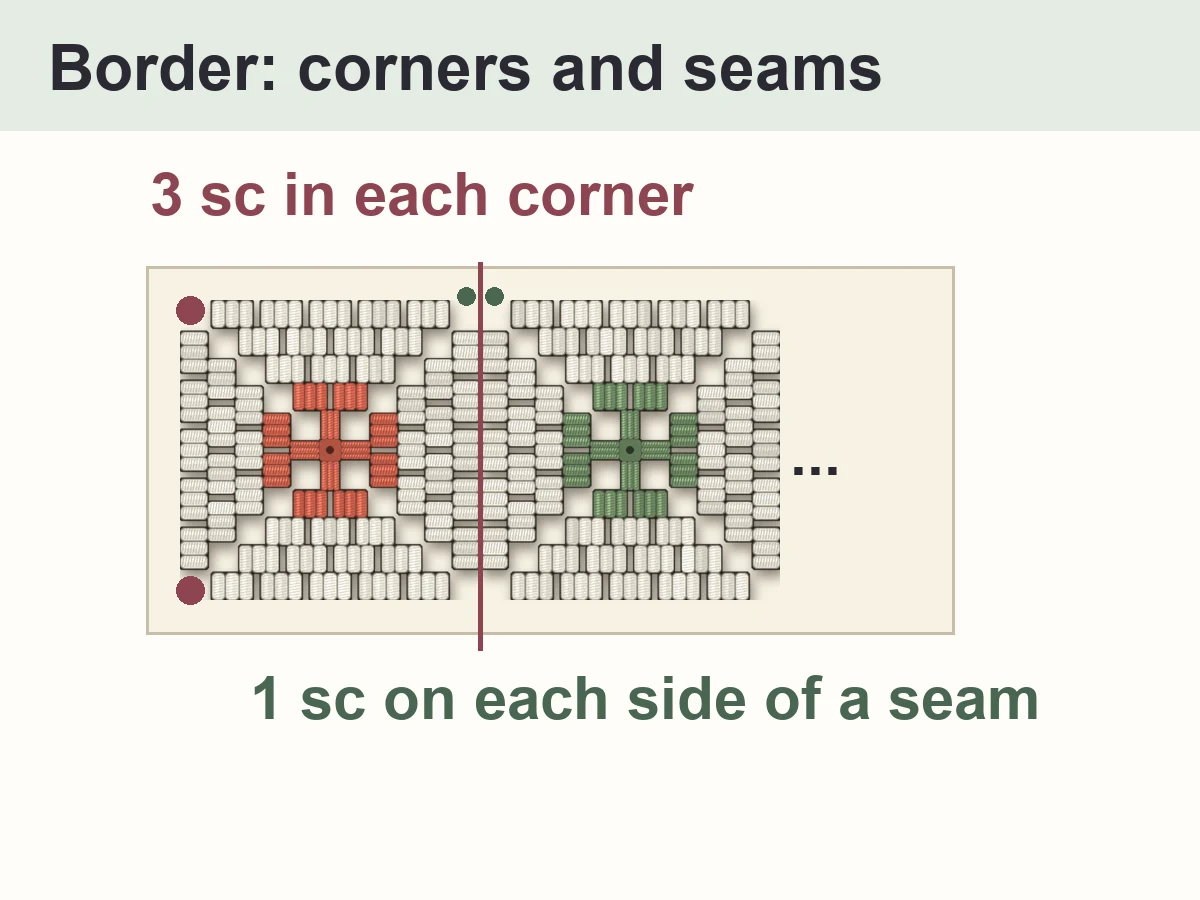
- With the right side facing you, join cream with sl st in any of the 4 outer ch-2 corner sps, so that a long side comes next as you work. Ch 1 (does not count as a stitch), 3 sc in the same corner sp. Long side: *sc in each of next 3 dc, [sc in the next ch-1 sp, sc in each of next 3 dc] 4 times, sc in the next corner sp, sc in the corner sp of the next square (one sc on each side of the seam); rep from * 5 more times (you are on the last square), sc in each of next 3 dc, [sc in the next ch-1 sp, sc in each of next 3 dc] 4 times (145 sc along the long side, not counting the corner sc). End: 3 sc in the next corner sp, sc in each of next 3 dc, [sc in the next ch-1 sp, sc in each of next 3 dc] 4 times, sc in the next corner sp, sc in the corner sp of the next square, sc in each of next 3 dc, [sc in the next ch-1 sp, sc in each of next 3 dc] 4 times (40 sc along the end), 3 sc in the next corner sp. Second long side: work the long side as before (145 sc, corners not included). Last end: 3 sc in the next corner sp, sc in each of next 3 dc, [sc in the next ch-1 sp, sc in each of next 3 dc] 4 times, sc in the next corner sp, sc in the corner sp of the next square, sc in each of next 3 dc, [sc in the next ch-1 sp, sc in each of next 3 dc] 4 times. Join with sl st in the first sc (382 sc). 382 sc
- Ch 1 (does not count as a stitch), sc in the first sc, 3 sc in the next sc (the center sc of the corner), sc in each of next 147 sc, 3 sc in the next sc, sc in each of next 42 sc, 3 sc in the next sc, sc in each of next 147 sc, 3 sc in the next sc, sc in each of next 41 sc. Join with sl st in the first sc (390 sc). Fasten off and weave in the ends. 390 sc
How to join the squares
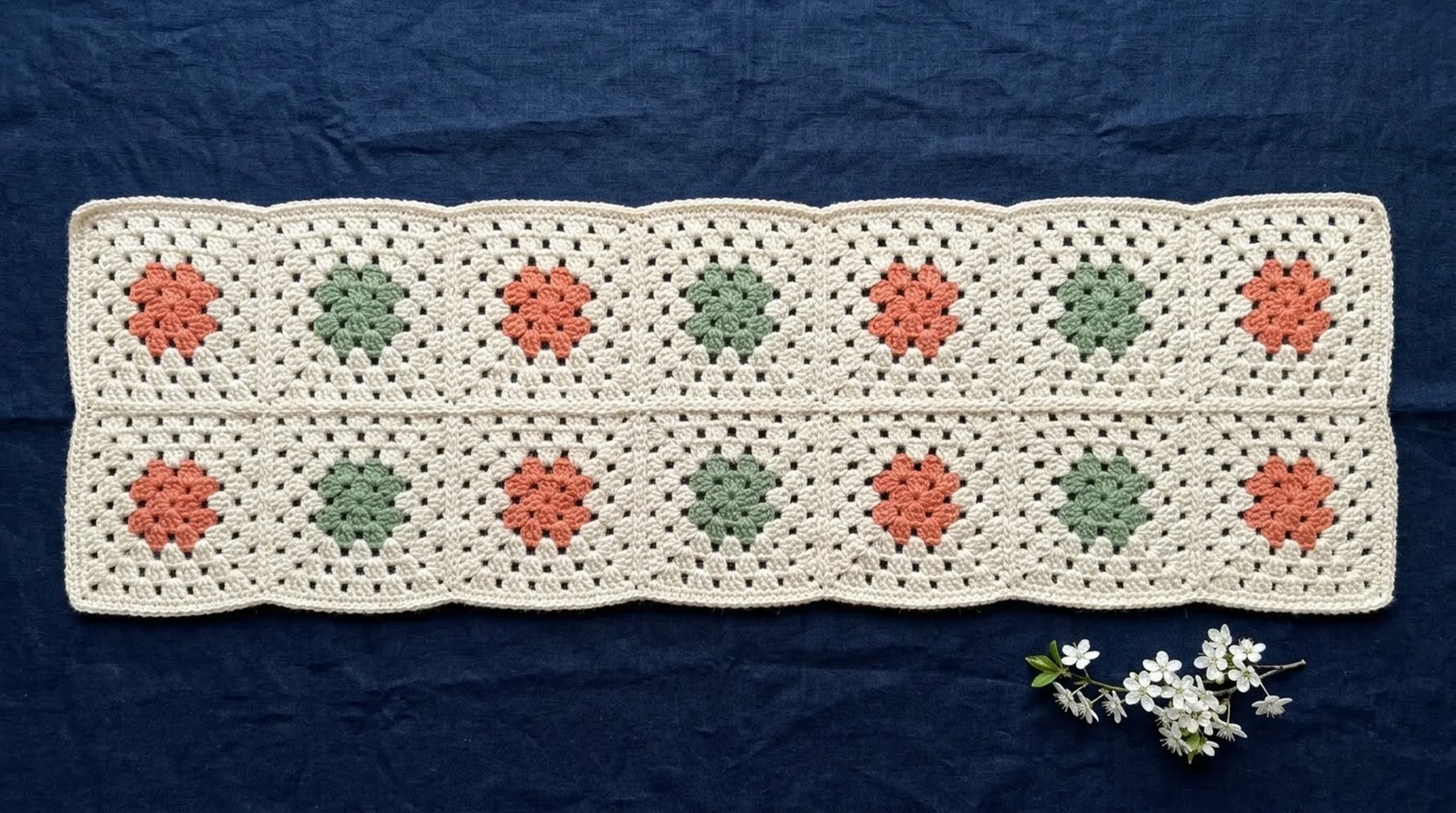
1 Block the squares
2 Join 2 strips
3 Join the strips
4 Border
Finishing
Weave the ends through the cream rounds and along the seams, then pin the runner flat, mist it and let it dry before it goes on the table.
Design notes
- Each square edge gives 19 places between its corner spaces: 15 dc and 4 ch-1 spaces. Along a long side, 7 squares give 7 x 19 sc plus 2 sc at each of the 6 seams: 145 sc. Along a short end, 2 squares give 40 sc.
- Border Rnd 2 adds 2 sc at each of the 4 corners (3 sc in each corner center sc), so the corners stay square and flat.
- An odd number of squares per strip keeps coral at both ends.
Tips
- Work the 8 coral centers in one go, then the 6 sage ones: you change yarn less often.
- Join the cream for Rnd 3 in a corner space: the color change hides in the corner.
- Lay all 14 squares on the table before the first seam: coral at both ends, each coral facing a coral.
- Mark the center sc of each outer corner in Border Rnd 1 with a stitch marker: Rnd 2 puts its 3 sc there.
Common mistakes
- Seams worked too tight: keep the slip stitches loose or the runner puckers.
- Missing one of the 2 corner spaces at a seam in Border Rnd 1: the count comes out short.
- A coral facing a sage when you join the strips: lay them out side by side first.
Make it your own
- Shorter runner, about 31 in: 2 strips of 5 squares (6 coral, 4 sage). Border Rnd 1: 103 sc along each long side instead of 145 (298 sc in all, rep from * 3 more times). Border Rnd 2: sc in each of next 105 sc along each long side instead of 147 (306 sc). Yarn about 40 yd coral, 25 yd sage, 270 yd cream; about 9 to 12 hours (estimates).
- Softer pastels: swap the coral and sage for any 2 colors you like, or use one color for all the centers; the counts stay the same.
Care
- Wash it as the yarn label says (a gentle hand wash suits most worsted yarns), then lay it flat to dry so the squares stay square.
More granny square patterns
- Daisy Granny Square Blanket — a spring blanket made of daisy granny squares
- How to Crochet a Granny Square — new to granny squares? Start here, one picture per round
- Easy Granny Square Blanket — the same classic square, in a blanket in 3 sizes
- Christmas Granny Square Table Runner — this same runner in red, green and cream for December
FAQ
What colors work for a spring or Easter table runner?
Coral and sage green with cream, as here, read as spring without being too sweet. Any 2 colors work for the centers (pale yellow and lilac, pink and mint): the stitch counts stay the same.
Can I finish it before Easter?
It takes about 12 to 16 hours in all (an estimate, not timed): 14 squares, the seams, the border and the ends. A few evenings a week from early March is a comfortable pace for Easter on March 28, 2027.
How big is this spring table runner?
About 13 in wide and 43 in long with the border; the 10-square version is about 31 in long (estimates: your tension decides).
How much coral, sage and cream yarn do I need?
About 50 yd of coral, 40 yd of sage green and 370 yd of cream worsted weight yarn (estimates with a 30 % margin). Buy all the cream from one dye lot.
Can I sell the runners I make?
Yes, you may sell what you crochet. Please don't sell or repost the pattern; link to this page.
Copyright
© 2026 CookZya. Free for personal use: you may make and sell what you crochet. Please don't sell, copy or repost this pattern; link to it instead.